Free conversion audit
Get a tailored action plan based on your current funnel.
What Is Conversion Rate Optimization?
Conversion rate optimization (CRO) is the process of increasing the percentage of website visitors who take a desired action — making a purchase, submitting a form, booking a call, or signing up for a trial. Instead of spending more to get more traffic, CRO focuses on getting more value from the traffic you already have.
Your conversion rate is calculated as: (Conversions ÷ Visitors) × 100. If 10,000 people visit your site in a month and 150 of them submit an inquiry form, your conversion rate is 1.5%.
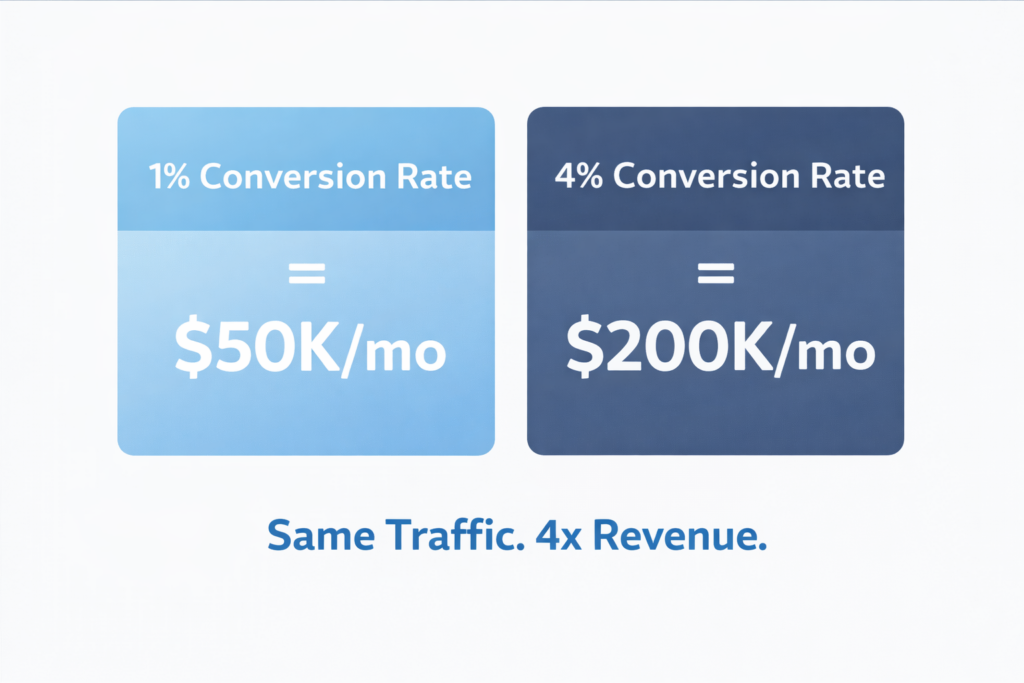
The reason CRO is one of the highest-ROI activities in digital marketing is simple math. If you double your conversion rate from 1% to 2%, you double your revenue — without increasing your ad budget, without additional SEO effort, without more content. The same traffic produces twice the output. That effect compounds every month without adding a single dollar to your ad spend.
Why Most Businesses Underinvest in CRO
Most businesses default to buying more traffic when results plateau. It feels intuitive — more visitors should mean more conversions. But when your conversion rate is 1%, buying double the traffic still returns a 1% conversion rate. You’ve doubled your cost, not your efficiency.
The businesses that grow fastest treat CRO as infrastructure — a permanent function of the business, not a one-time project. According to industry benchmarks, the top 25% of websites convert at more than 5%, while the median sits around 2%. The gap between median and top-quartile performance isn’t traffic. It’s conversion architecture.
How CRO Works: The 5-Step Process
Effective conversion rate optimization isn’t guesswork. It follows a repeatable process:
- Measure — Define your conversion events and establish baseline metrics in GA4. Know exactly where in the funnel users are dropping off.
- Analyze — Use session recordings, heatmaps, and funnel reports to understand the behavior behind the numbers. Tools like Microsoft Clarity reveal where users click, scroll, and abandon.
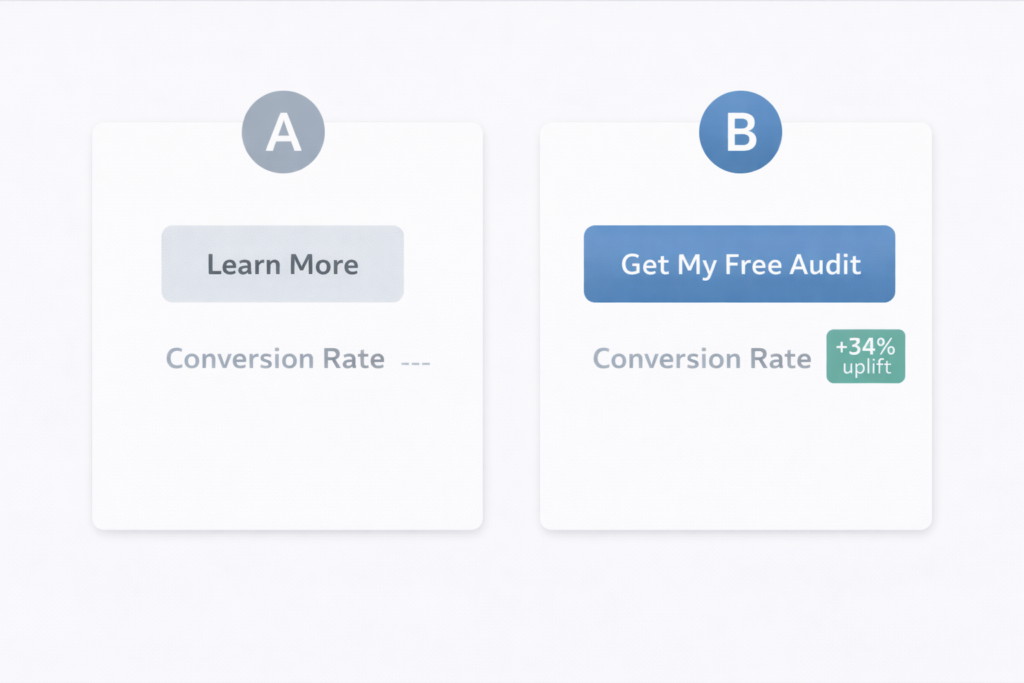
- Hypothesize — Form a specific, testable hypothesis: “Changing the CTA copy from ‘Submit’ to ‘Get My Free Audit’ will increase form submissions by reducing friction at the decision point.”
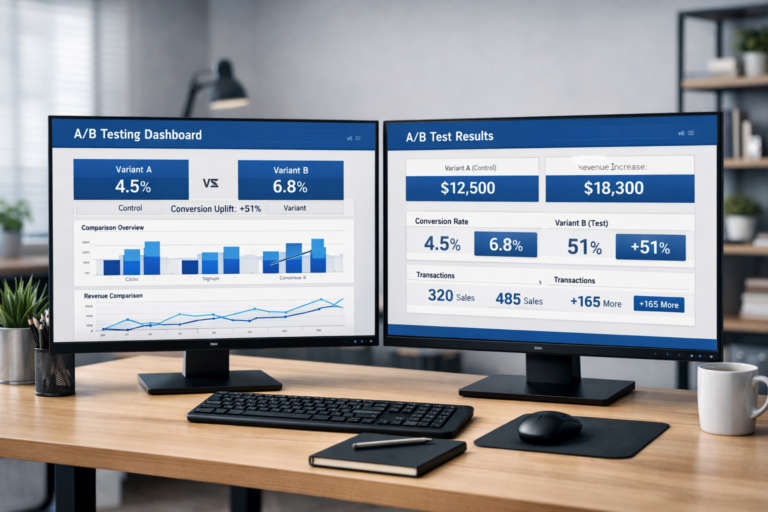
- Test — Run a controlled A/B test. Split traffic 50/50 between the control and the variant. Let it run until you hit statistical significance (minimum 95% confidence, ideally 500+ conversions per variant).
- Implement — Apply winning variants permanently. Document what worked and why. Feed the insight back into the next hypothesis.
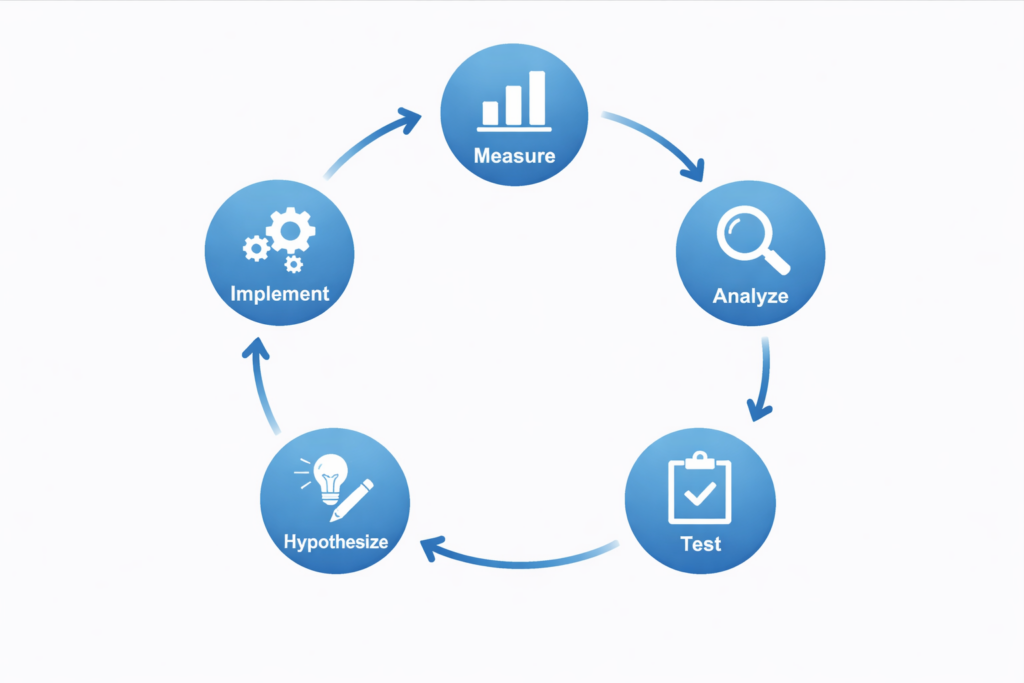
The power of this process is its compounding nature. A 10% lift from one test, followed by a 12% lift from the next, followed by an 8% lift from a third — stacked together, that’s a 33% total improvement from three experiments. Most businesses never run experiment one.
The Core Elements of Conversion Rate Optimization
Value Proposition Clarity
The single most important factor in any CRO engagement is whether your value proposition is immediately clear. A visitor should be able to answer three questions within 5 seconds of landing: What is this? Who is it for? Why should I act now?
Vague headlines like “We Help Businesses Grow” fail all three. Specific headlines like “CRO for Shopify Stores — Get More Sales From the Traffic You Already Have” pass all three. Clarity outperforms cleverness in every test we run.
A/B Testing
A/B testing is the backbone of CRO. You create two versions of a page element — a headline, a CTA button, a form layout, a hero image — and split your traffic between them. The version that produces more conversions wins.
The most common mistake is testing too many variables at once (multivariate testing without sufficient traffic) or calling results too early. You need statistical significance before drawing conclusions — typically 95% confidence and enough conversions to be sure the result isn’t random variance. A one-week test with 50 conversions is not statistically valid. A three-week test with 600 conversions is.
High-impact elements to test first: headline copy, CTA button text and color, hero section layout, form length, pricing page structure, and trust signal placement.
User Experience (UX) Design
Friction is the enemy of conversion. Every unnecessary click, form field, loading second, and confusing UI element reduces the probability that a visitor completes your goal. CRO-driven UX design removes friction at every step of the funnel.
On mobile — which accounts for over 60% of web traffic — UX failures are amplified. Buttons too small to tap, forms that don’t autofill, checkout flows with unnecessary steps, and pop-ups that block content all contribute to mobile conversion rates that average less than half of desktop. Mobile UX isn’t a nice-to-have. It’s where most of your conversions are being lost.
Page Speed Optimization
Speed is a conversion variable. Every additional second of load time reduces conversions by an estimated 7%. Google’s Core Web Vital target for Largest Contentful Paint (LCP) is under 2.5 seconds. Most websites miss it on mobile.
The relationship between page speed and CRO is direct: a faster page means more users stay long enough to see your offer, understand your value proposition, and convert. Speed optimization is often the highest-ROI CRO intervention — especially for sites running paid traffic where every visitor has a hard cost.
Trust and Social Proof
Visitors don’t convert when they don’t trust you. Trust signals — star ratings, client logos, testimonials with specific outcomes, security badges, money-back guarantees — reduce the perceived risk of taking action. Placing trust signals adjacent to your CTA (not in a separate section lower on the page) is one of the most consistent conversion lifts in CRO testing.
Generic testimonials (“Great service!”) perform poorly. Specific outcome-based testimonials (“We increased our form submissions by 40% in the first month”) perform significantly better because they answer the prospective buyer’s implicit question: will this work for me?
CRO for Landing Pages
Landing pages — especially those receiving paid traffic — are the highest-leverage CRO targets. A page converting at 2% fed by $5,000/month in paid ads generates 100 leads. The same page at 4% generates 200 leads from the same budget. That’s 100 additional leads per month at zero additional cost.
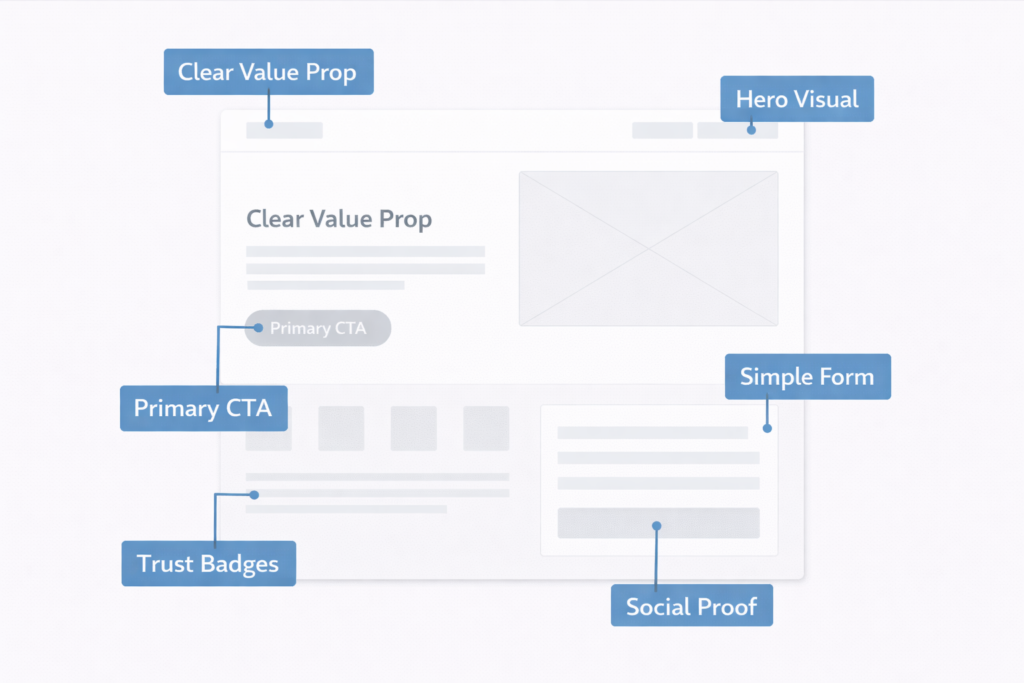
Every landing page should contain these elements above the fold:
- A specific headline (what you do + who it’s for)
- A concise subheadline (the primary benefit or outcome)
- A single, prominent CTA button with outcome-oriented copy
- At least one trust signal (a client logo, review count, or credential)
- A hero visual that reinforces the offer (not stock photography)
Below the fold: social proof, a breakdown of what the visitor gets, objection handling, and a repeated CTA. The page should answer every question a qualified buyer might have — without making them search for the answers.
CRO for Ecommerce
Ecommerce CRO focuses on three primary conversion points: product pages, cart, and checkout. Each has distinct friction patterns and distinct fixes.
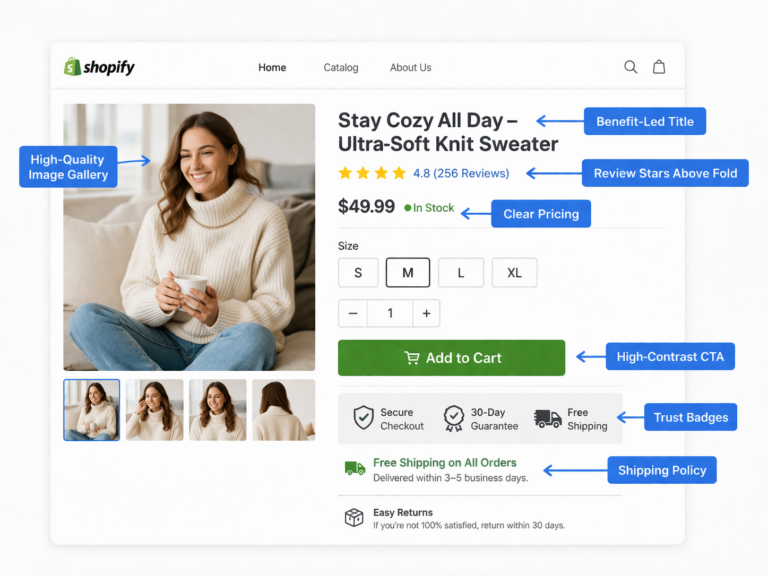
Product pages convert poorly when images are low quality, reviews are absent or hard to find, shipping information is unclear, and the add-to-cart button isn’t prominent. The fix: high-quality product imagery, reviews surfaced above the fold, delivery expectations stated explicitly, and a single dominant CTA.
Cart abandonment — the industry average is 70%+ — is driven by unexpected costs (shipping, taxes), forced account creation, and a lack of trust signals near the payment flow. Address these three and you’ll recover a meaningful percentage of abandoned carts without a single additional visitor.
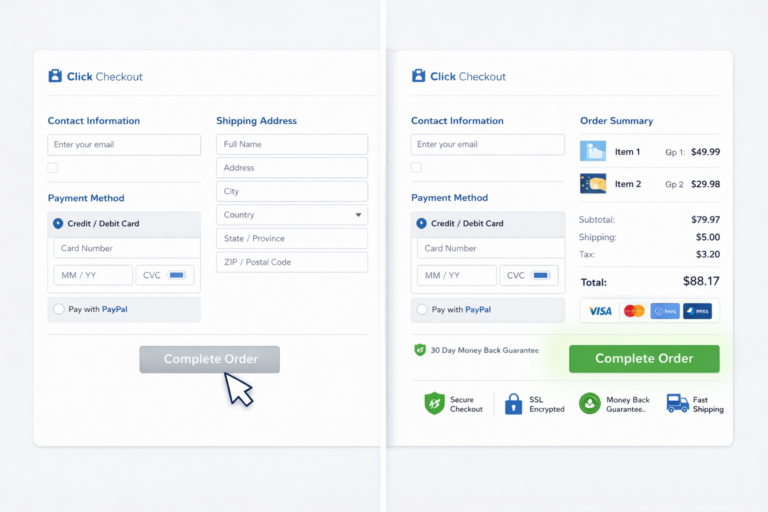
Checkout optimization is the highest-value ecommerce CRO target. Every additional step or field in checkout reduces completion rates. Best practice: guest checkout as default, address autocomplete via Google Places API, persistent cart across sessions, and an inline order summary visible throughout checkout.
CRO Metrics You Need to Track
Running CRO without clean measurement is building on sand. These are the metrics that matter:
- Macro conversion rate — The percentage of sessions that complete your primary goal (purchase, form submission, trial signup). Track this per page, per traffic source, and per device type.
- Micro conversion rate — Intermediate actions that indicate intent: add-to-cart rate, video play rate, pricing page visits, scroll depth past 75%. These signal where users are engaged before they convert.
- Bounce rate by traffic source — High bounce from a specific channel often indicates a message-match failure between the ad and the landing page copy.
- Form completion rate — What percentage of users who start your form finish it? A low completion rate points directly to form friction.
- Revenue per visitor (RPV) — The definitive ecommerce CRO metric. Combines conversion rate and average order value into a single measure of page efficiency.
Common CRO Mistakes That Kill Results
Most CRO programs fail for predictable reasons:
- Testing without enough traffic. Low-traffic tests produce false positives. If your page gets 500 visits per month, you cannot run a valid two-variant test in 30 days. Build traffic first or focus on higher-traffic pages.
- Optimizing the wrong page. Most CRO effort goes into homepages. Most conversions happen on product pages, pricing pages, and landing pages. Optimize where the decision happens.
- Changing too many things at once. If you update the headline, CTA, layout, and form in one deployment, you can’t attribute the result to any single change. Test one variable at a time.
- Ignoring mobile. Optimizing only the desktop experience means ignoring the majority of your traffic. Every test should include a mobile-specific variant analysis.
- Calling tests too early. Peeking at results daily and stopping tests when you see a lift introduces bias. Commit to your test duration before starting and don’t stop early.
Real Example: CRO That Produced 3.5× More Leads
A B2B services client was generating 1,400 monthly visitors to their contact page with a 2.1% form submission rate — roughly 29 leads per month. A CRO audit identified four issues:
- The form had 9 fields (name, company, role, phone, email, budget, timeline, service interest, how did you hear about us)
- The CTA button said “Send Message”
- No trust signals appeared on the page
- The page had no value proposition — just a form
Changes made: form reduced to 4 fields (name, email, website, what you need help with), CTA copy changed to “Get My Free Audit”, three client logos added above the form, a one-sentence value prop added at the top of the form section.
Result: form submission rate increased from 2.1% to 7.4% in 6 weeks. On 1,400 monthly visitors, that’s 104 leads per month versus 29 — from the same traffic, the same page, without touching the ad budget.
How Much Does CRO Cost — and What’s the ROI?
CRO engagements vary widely in scope. A focused audit and implementation sprint for a single funnel typically runs $1,500–$5,000. A full ongoing CRO program with continuous testing, analytics management, and monthly reporting runs $2,500–$8,000/month depending on site complexity and traffic volume.
The ROI calculation is straightforward. If your site generates $40,000/month in revenue at a 1.5% conversion rate, and a CRO program lifts you to 2.5%, you’ve added $26,667/month in revenue from the same traffic. That’s a 10×+ return on a $2,500/month investment — and the lift is permanent, not dependent on continued spend.
For businesses running paid traffic, the ROI is even clearer: a higher conversion rate means a lower cost per acquisition on every campaign, immediately improving ROAS across every channel without touching the ads themselves.
Ready to Start Optimizing? Get a Free CRO Audit.
The gap between your current conversion rate and what’s possible is almost always larger than you expect. Most sites we audit have 3–5 high-impact issues that can be identified and fixed within the first 30 days — without a redesign, without more traffic, and without guesswork.
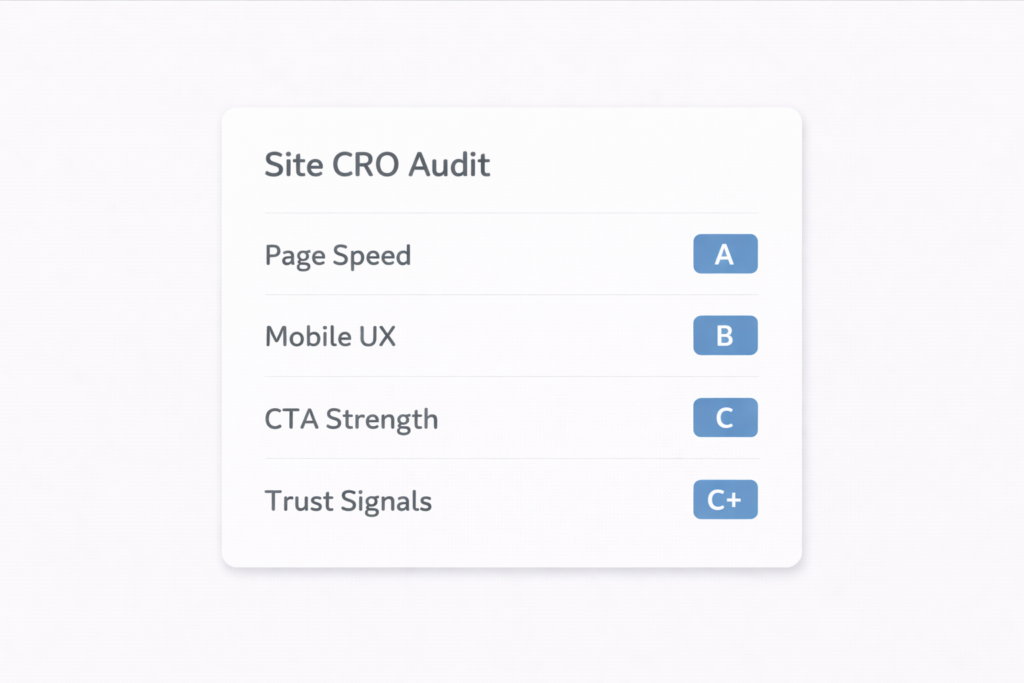
At Site OptimizR, we run a full free CRO audit covering your top landing pages, conversion funnel, mobile experience, page speed, and trust signal placement. You’ll get a prioritized action list — not a generic PDF — with the specific changes that will move your conversion rate first.
Most clients see their first measurable lift within 30 days of implementation. Book your free audit and find out what your traffic is actually worth.