
Free conversion audit
Get a tailored action plan based on your current funnel.
Yotpo vs Judge.me is a choice between two very different operating models for Shopify reviews. Judge.me offers a focused review product with a free plan and a flat $15 paid tier. Yotpo offers free and paid review tiers that can extend into a broader customer-marketing platform, with pricing and feature access that change as your requirements grow.
The lower invoice does not automatically produce the better result. Your real decision depends on review volume, visual content, Google programs, integrations, moderation, international requirements, storefront performance, and how safely your existing review archive can move.
This comparison uses official vendor pages, help documentation, and Shopify App Store listings checked on September 3, 2026. It gives you the current public pricing, a practical test plan, and a condition-based verdict without assuming either platform will increase conversion by a guaranteed amount.
Yotpo vs Judge.me: The Quick Answer
Choose Judge.me when you want predictable cost and strong core review coverage. Its Free plan includes unlimited product and store reviews, photo and video reviews, rich snippets, displays, and support. The $15-per-month Awesome plan adds advanced customization, AI features, social and Google Shopping capabilities, referrals, coupons, and its full integration set.
Choose Yotpo when its deeper review program or wider platform is an explicit requirement. Yotpo is a better candidate when you need its advanced questions, smart sorting, seller-rating path, enterprise governance, or a coordinated reviews-and-loyalty stack. Those benefits must be tied to workflows your team will actually operate.
If you only need reliable review collection and display, Judge.me is the simpler starting point. If reviews are one part of a multi-channel customer-content program, test Yotpo against a written capability map instead of comparing headline prices alone.
Yotpo vs Judge.me Pricing in September 2026
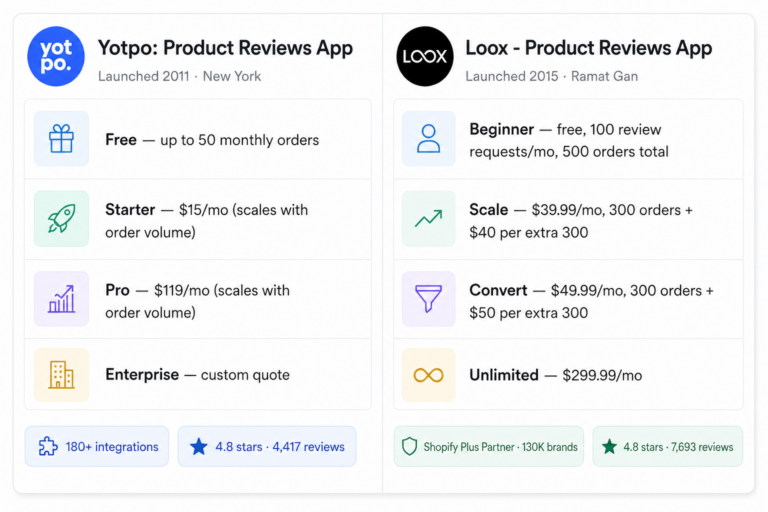
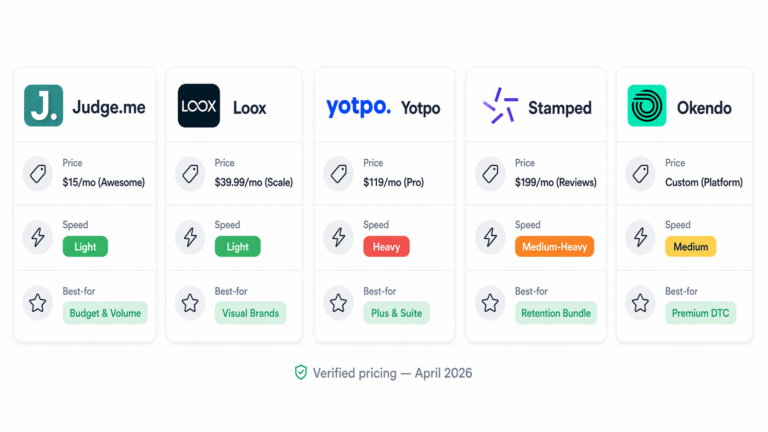
The Yotpo Shopify App Store listing shows Free for up to 50 monthly orders, Starter from $15 per month or $144 per year, and Pro from $119 per month or $1,068 per year. Yotpo notes that Starter and Pro pricing changes with order volume, so those figures are entry prices rather than a universal quote.
The Judge.me pricing page lists Free at $0 and Awesome at $15 per month. Judge.me states that both plans include unlimited reviews and that Awesome does not add usage or order-volume charges. Its help center says the paid plan is monthly only, with a one-time 15-day trial for eligible stores.
| Public plan | Published price | Important boundary |
|---|---|---|
| Yotpo Free | $0 | Up to 50 monthly orders |
| Yotpo Starter | From $15 monthly or $144 annually | Price changes with order volume |
| Yotpo Pro | From $119 monthly or $1,068 annually | Price changes with order volume |
| Judge.me Free | $0 | Unlimited reviews; feature limits apply |
| Judge.me Awesome | $15 monthly | Flat public price; no annual plan |
Request the exact Yotpo quote for your expected order band and required modules. Compare twelve-month cost, not the first invoice, and record what happens when monthly orders exceed the current tier.

Review Collection and Storefront Display
Both apps can request, moderate, and display product reviews. Both support photo and video content, store reviews, automated requests, and on-site review widgets. The question is how much control you need and which paid gate unlocks it.
Yotpo Starter adds photo and video reviews, Google rich snippets, Google Shopping Ads support, a reviews carousel, and coupons with email upsells. Pro adds custom questions, AI review summaries, smart sorting, Google Seller Rating capabilities, and technical email support. Yotpo’s product pages also describe in-mail review collection, two-in-one product and site review requests, and cross-channel syndication.
Judge.me Free includes unlimited photo and video reviews, review requests, core widgets, and rich snippets. Awesome adds all widgets, deeper customization, AI summaries and responses, integrations, social sharing, Google Shopping tools, referrals, and coupons. That makes the paid decision less about review volume and more about customization and distribution.

Shopify Review Widgets and Product Page Conversion
A review app does not improve a product page merely because it is installed. The useful test is whether shoppers can see credible proof, filter it, understand common themes, and return to the purchase controls without friction.
On a duplicate theme, place each app on the same representative product. Test the rating summary, photo gallery, filters, questions and answers, review form, and mobile spacing. Check keyboard navigation, focus visibility, color contrast, and whether the widget causes layout movement while loading.
Use the surrounding page as part of the evaluation. Our Shopify product page optimization guide explains how proof, variant selection, delivery clarity, and add-to-cart controls work together. A feature-rich widget that pushes the offer below the fold can lose to a simpler implementation.
Google, AI, and Integration Requirements
Separate organic review snippets, Shopping Product Ratings, and merchant-level Seller Ratings. They use different eligibility rules, and no app can promise that Google will display stars.
Google’s review snippet documentation says valid structured data can make a page eligible for enhanced search results, but appearance is not guaranteed. Google Merchant Center’s Product Ratings guidance requires program eligibility, policy compliance, product matching, and a qualifying review feed.
Yotpo Pro lists Google Seller Rating, custom questions, smart sorting, and AI review summaries. Yotpo also positions its review content for search and AI discovery across its broader platform. Judge.me Awesome lists Google Shopping, AI summaries, AI-assisted replies, translation, and all integrations at its flat paid price.
Verify the exact destination you need. Ask whether imported reviews are eligible, how often feeds update, which product identifiers are required, and whether the feature is included in your plan. For integrations, test the actual event and fields sent to Klaviyo, Gorgias, your loyalty system, support desk, and analytics stack.

Yotpo vs Judge.me for International Stores
International review programs need more than translated buttons. You must test request emails, submission forms, storefront displays, moderation, consent language, and the way reviews map across regional storefronts.
Judge.me says its AI translation covers 38 languages and that its paid tier includes all integrations. Yotpo supports Shopify and Shopify Plus alongside several other commerce platforms, and its current product messaging includes automatic translation and global syndication in higher-level review programs.
Build a language-and-market matrix before choosing. Include each storefront domain, locale, currency, catalog mapping, email language, moderation owner, and syndication destination. A multilingual label is not enough if shoppers receive the wrong request language or a translated review maps to the wrong regional product.
Performance and Theme Compatibility
Do not accept a universal claim that either app is faster. Widget weight depends on the theme, enabled features, number of review components, consent tooling, and when the scripts load.
- Duplicate the current production theme and create one representative product test.
- Capture mobile and desktop baselines for
LCP,INP, andCLS. - Enable the same visible review features in each app.
- Repeat lab tests and inspect real-user performance after a controlled release.
- Check review content, schema, and functionality with consent accepted and declined.
Run multiple samples because one synthetic test can be noisy. Use our website speed test as a starting point, then inspect requests and long tasks in the browser. The goal is not the smallest script count; it is useful social proof without a material buying-path penalty.
Migration From Yotpo to Judge.me or Back
Review migration is rarely lossless. Text, rating, date, reviewer identity, product handle, images, videos, merchant replies, custom questions, verification status, incentives, and syndication eligibility can each move differently.
Judge.me’s migration documentation supports imports from Yotpo and other platforms, but you should verify the exact export fields. Its own export guide notes that some data—such as videos, order details, verified status, and tags—does not appear in standard CSV exports. Yotpo provides moderation and data tools, but export access and field coverage depend on the account and workflow.
- Export the complete source archive and store it securely before changing either app.
- Import a difficult sample containing images, videos, replies, variants, and incentives.
- Reconcile record counts and manually inspect at least ten representative products.
- Validate organic schema and Google feed eligibility separately from storefront display.
- Keep the source system available until collection, display, syndication, and rollback pass.

Worked Example: A Store With 1,200 Monthly Orders
Consider a hypothetical Shopify store processing 1,200 orders per month. Judge.me Awesome remains $15 per month under its current public pricing. Yotpo Starter and Pro are advertised from $15 and $119, but Yotpo says pricing changes by order volume, so the store needs a written quote rather than multiplying an entry price by twelve.
The store should list the Yotpo-only capabilities it needs, attach an operational owner to each one, and estimate the annual cost difference after order-based pricing. If the team needs advanced questions, smart sorting, seller-rating support, or a connected Yotpo program, the premium may be rational. If it needs review requests, visual reviews, rich snippets, integrations, and customization, Judge.me provides a lower-risk budget baseline.
This example does not predict conversion lift. It defines the decision hurdle: Yotpo-specific workflows should return more value than their incremental software and operating cost.
Which Stores Should Choose Judge.me or Yotpo?
Choose Judge.me when simplicity and predictable cost lead
- You want unlimited reviews without an order-volume price ladder.
- You need strong review collection and display on a small budget.
- You want AI tools, Google Shopping support, referrals, customization, and integrations in one paid tier.
- You prefer to keep reviews separate from a larger loyalty or customer-marketing suite.
Choose Yotpo when a broader review program earns its cost
- You need advanced review questions, sorting, seller-rating capabilities, or enterprise governance.
- You plan to coordinate reviews with Yotpo Loyalty or other Yotpo products.
- Your team can operate the additional segmentation, syndication, and optimization workflows.
- You have verified your order-volume quote, contract terms, data access, and migration path.
For a broader shortlist, compare the alternatives in our best Shopify reviews app guide. Use this page when your final decision is specifically Judge.me versus Yotpo.
How to Test Yotpo and Judge.me Before Choosing
- Define requirements. List review types, languages, Google programs, integrations, permissions, and export fields.
- Price the expected volume. Use twelve-month order forecasts and include required modules, implementation, and annual commitments.
- Build the same storefront test. Use identical products, review content, placement, and device widths.
- Run a sample migration. Include difficult media and metadata, then reconcile both systems.
- Validate measurement. Confirm analytics events, email properties, schema, feed status, and page-speed impact.
- Document rollback. Keep exports, theme backups, owners, and a cutover window before production launch.
A seven-day test is usually enough to expose setup friction and widget issues, but collection and syndication quality need a longer observation window. Avoid changing request timing, incentives, widget placement, and platform simultaneously because you will not know which change produced the result.
Get a Free Shopify Reviews Audit
Your review platform should make proof easier to collect, trust easier to evaluate, and purchase decisions easier to complete. Site OptimizR can review your current request flow, product-page widgets, schema, Google setup, integrations, mobile experience, and migration risk.
Book your free Shopify reviews audit before you sign a longer contract or move a live review archive. You will receive a prioritized plan tied to your store, stack, and conversion goals.
If Loox is the other finalist, continue with the exact Yotpo vs Loox comparison.