Free conversion audit
Get a tailored action plan based on your current funnel.
Why an A/B Testing Agency Beats Guessing at Growth
An A/B testing agency exists for one reason: to find the changes on your site that actually increase revenue, then prove it with data before you commit. If your pages already get traffic but conversions are flat, more ad spend is not the answer. Better decisions are.
The problem is that most businesses either skip testing entirely or run scattered experiments with no research foundation, no measurement plan, and no way to tell whether a “winner” actually moved the bottom line. That is where working with the right A/B testing company changes the math.
This guide covers what a real testing agency does, the red flags that separate serious partners from surface-level vendors, what to ask before you hire, and how to know whether outsourcing experimentation is the right move for your business right now.
What Does an A/B Testing Agency Actually Do?
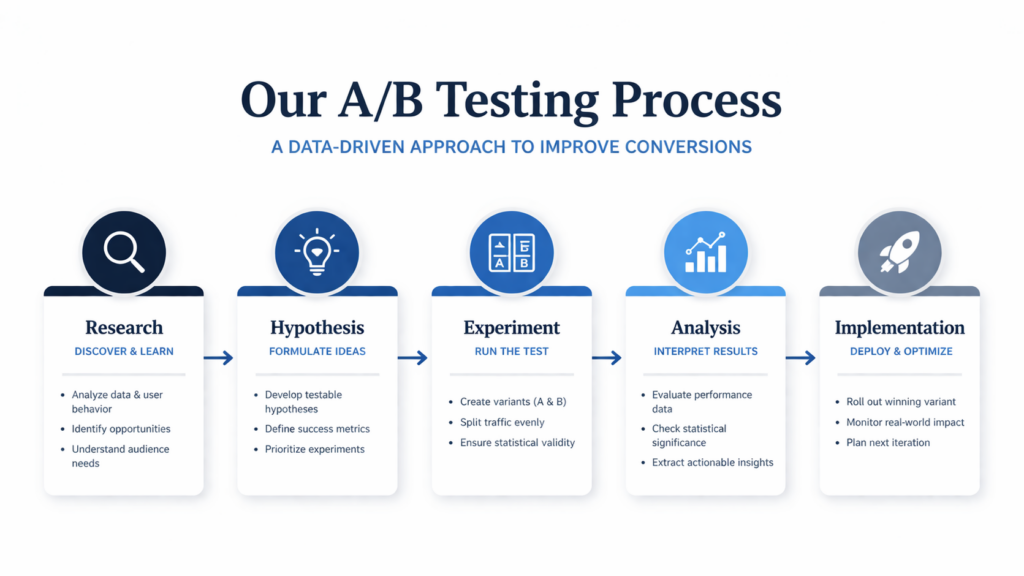
A good A/B testing agency does not just set up experiments and report on click rates. The experiment itself is only one step in a larger system designed to find and fix the bottlenecks that cost you the most money.
The full scope typically looks like this:
- Research and diagnosis. Analyzing your funnel data, heatmaps, session recordings, and user behavior to find where visitors are dropping off and why.
- Hypothesis development. Building specific, testable predictions about what a change will do and which metric it should move.
- Experiment design and build. Creating the test variations, setting up the tooling, defining sample size requirements, and configuring measurement.
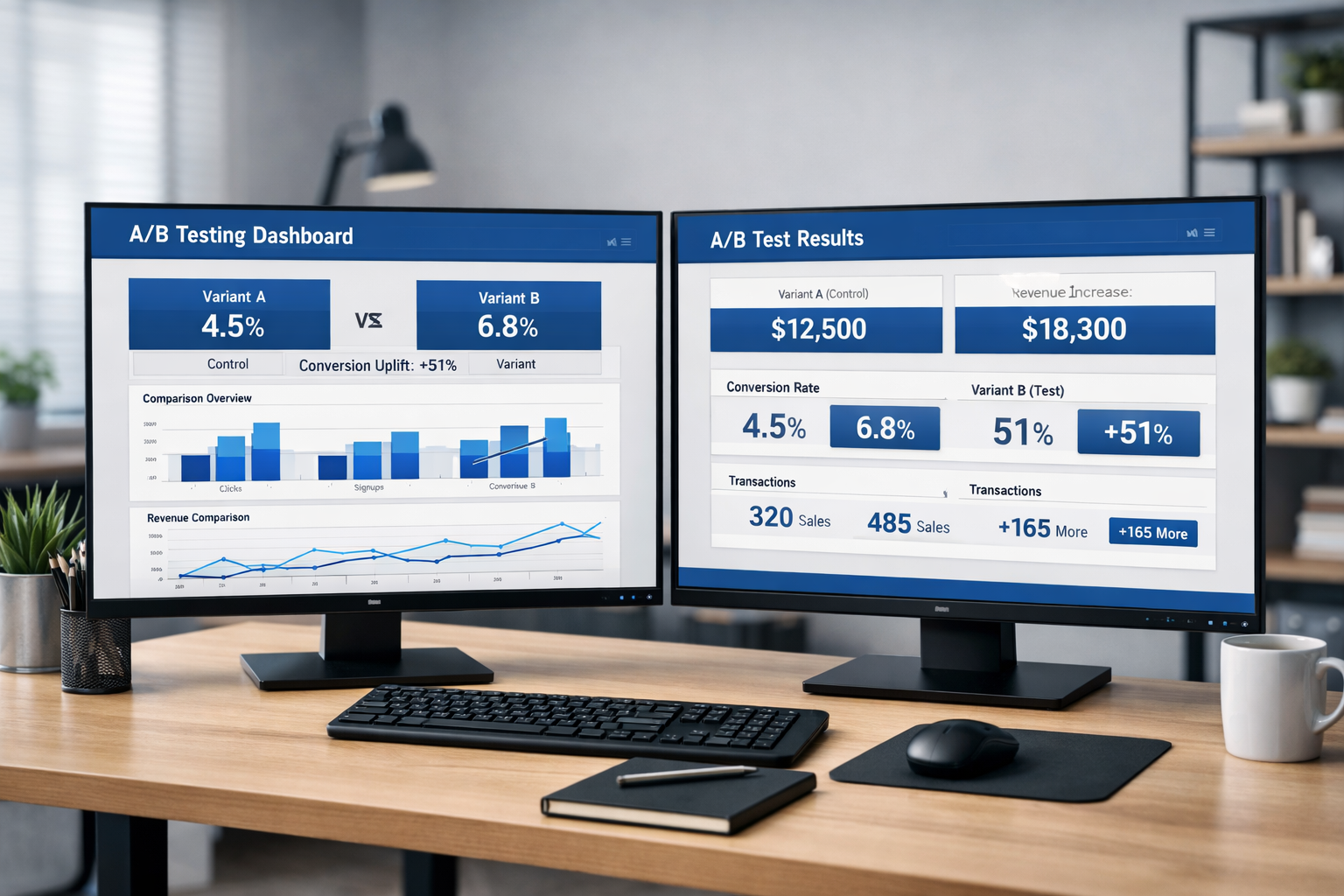
- Analysis and interpretation. Reading the results in context — not just “Variant B got more clicks,” but whether the lift is statistically reliable, whether it held across segments, and whether downstream metrics improved.
- Implementation and iteration. Shipping the winner into production code, documenting the learning, and feeding it into the next hypothesis.
That is the difference between a testing vendor and a growth partner. One runs tools. The other builds a compounding system where every test, even the ones that lose, makes your next decision sharper.
When You Need an A/B Testing Agency vs. Doing It Yourself
Not every business needs to hire an A/B testing agency right away. If your site gets under 5,000 monthly sessions or you have not set up proper analytics yet, there are more impactful things to fix first.
But if any of these apply, an agency will almost certainly pay for itself:
- You spend $10K+ per month on paid traffic and your landing pages convert below industry average.
- You redesigned your site recently and conversions dropped, but you do not know why.
- Your marketing team generates traffic, but lead quality or close rate is declining.
- You have tried running tests in-house but results are inconclusive or never get implemented.
- Your funnel has a clear drop-off point that nobody has been able to explain with analytics alone.
In all of these cases, the issue is not traffic volume. It is conversion efficiency. A CRO testing agency focuses on exactly that — extracting more value from the visitors you already have. If you are not sure where your biggest gaps are, start with a site optimizer checklist to identify the friction points worth testing first.
Red Flags When Hiring an A/B Testing Agency
The experimentation space has a credibility problem. Many agencies sell A/B testing consulting as a service but run shallow tests with no research, no measurement rigor, and no connection to actual business outcomes.
Watch for these warning signs:
- They lead with tools, not process. Knowing how to use VWO or Optimizely is not a strategy. If the first thing an agency talks about is their platform stack instead of how they diagnose problems, they are selling implementation, not growth.
- They promise a specific uplift. No honest testing partner guarantees “a 40% conversion increase.” Real experimentation produces learning. Some tests win, some lose, and the value is in the compounding insight — not a single number.
- They test cosmetic changes first. Button color, font size, icon swaps — these rarely move revenue. If their case studies are built around visual tweaks, they are optimizing for impressiveness, not impact.
- They skip research. An agency that jumps straight to test ideas without looking at your analytics, heatmaps, or user recordings is guessing. That defeats the entire point.
- They report on vanity metrics. Showing you click-through rate without downstream conversion, revenue per visitor, or lead quality is incomplete at best and misleading at worst.
- They treat every test as independent. Great experimentation programs build a knowledge base. Each test informs the next. If the agency has no documentation process and no learning library, they will repeat dead-end ideas.
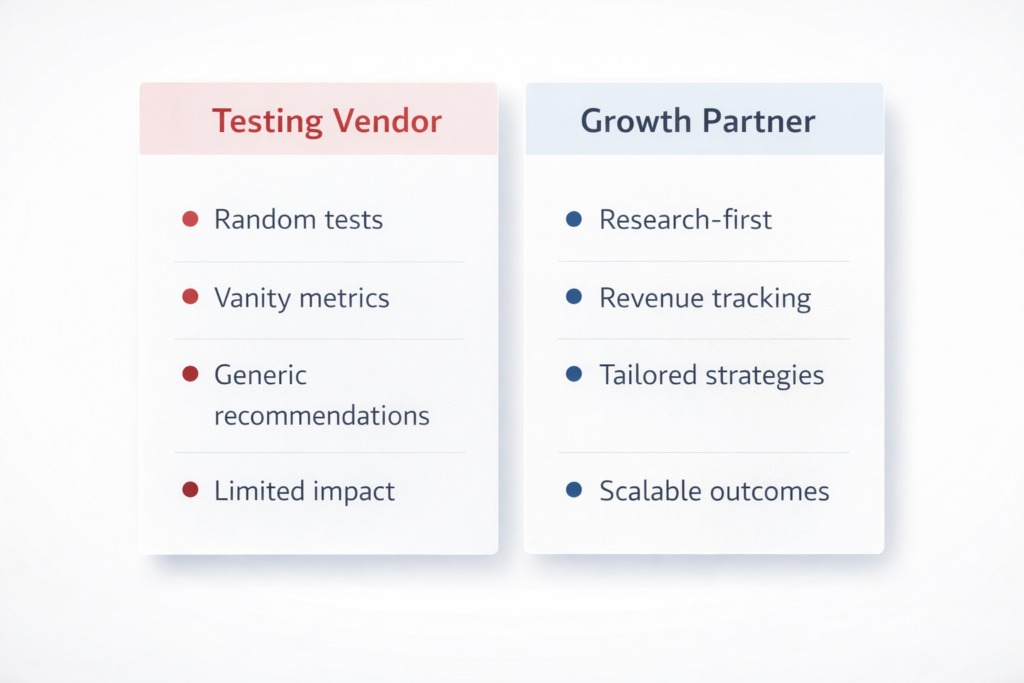
The best conversion rate optimization agency teams operate more like embedded strategists than external vendors. They understand your funnel, your economics, and your customer — and they design experiments that map to real business goals.
What to Ask Before You Hire
If you are evaluating a website testing agency, these questions will separate the serious partners from the surface-level ones fast.
- What does your research process look like before you run a test? You want to hear about analytics audits, heatmap analysis, session recordings, funnel mapping, and possibly user research — not “we brainstorm ideas on a call.”
- How do you define and prioritize hypotheses? Look for a structured framework like ICE (Impact, Confidence, Ease) or PIE (Potential, Importance, Ease). Agencies that prioritize by gut feel will burn through your budget on low-impact experiments.
- What is your minimum test duration and how do you handle sample size? If they call winners after three days on a site with 200 daily sessions, walk away. Reliable results require adequate traffic and full business cycles.
- How do you report results? You need to see primary conversion metrics, secondary metrics, guardrail metrics (like revenue per visitor or lead quality), and statistical confidence levels — not just “Variant B won.”
- What happens after a test wins? The winning variant needs to be implemented in production code, QA tested, and documented. If the agency’s job ends at “here is a slide deck,” you will lose the lift to implementation drift.
- Can you show me a test that lost and what you learned from it? Any agency can cherry-pick a winner. The ones worth hiring can articulate what a losing test taught them about the audience, the funnel, or the hypothesis — and how it shaped the next experiment.
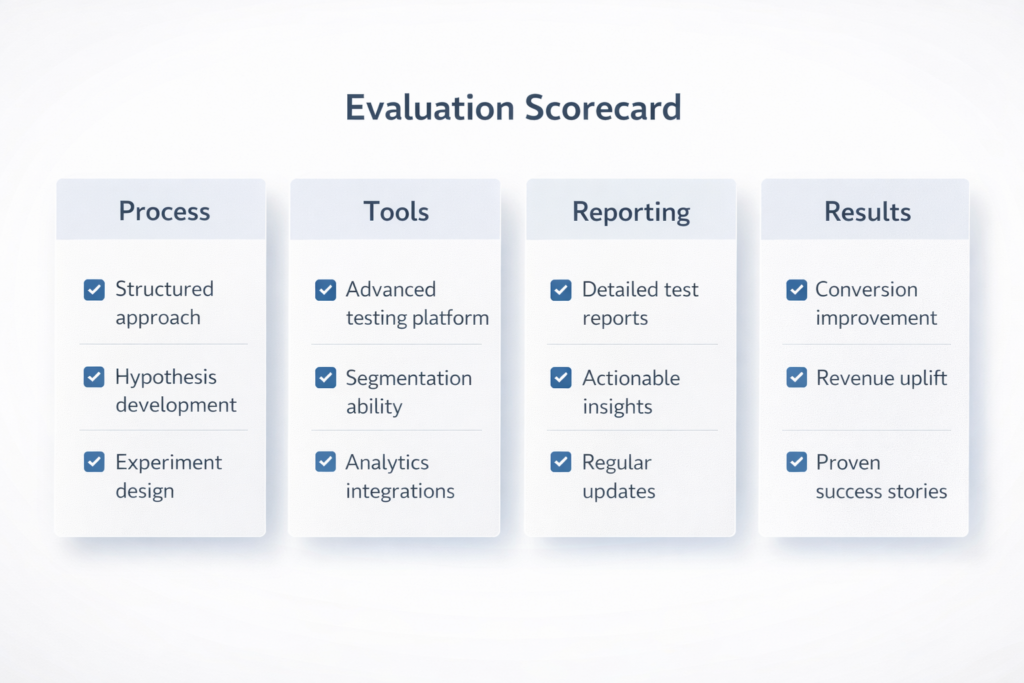
These questions are not designed to trip anyone up. They reveal whether the agency treats experimentation as a revenue system or a deliverable checklist.
In-House Testing vs. Hiring an Agency
Some companies have the resources to build an internal experimentation team. Most do not. Here is where each approach makes sense.
In-house testing works when:
- You have a full-time CRO analyst or growth team with experimentation experience.
- Your engineering team can implement and QA test variations without bottlenecking other projects.
- You already own and manage a testing platform (VWO, Optimizely, LaunchDarkly).
- Your experiment velocity is high enough to justify dedicated headcount — at least 3 to 4 tests per month.
Hiring an A/B testing agency works when:
- Your team has marketing and development talent but no dedicated experimentation capability.
- You need a structured testing program without hiring a full-time CRO specialist at $90K to $140K per year.
- You want access to research tools (heatmaps, session recordings, form analytics) that the agency already owns and knows how to interpret.
- You need faster time-to-insight — agencies with existing frameworks and cross-client pattern libraries can ramp up in weeks, not months.

The economics tip toward an agency for most small to mid-size businesses. A full-time CRO hire plus tool licenses plus engineering allocation can easily exceed $15K per month in loaded cost. A focused split testing services engagement can deliver comparable output at a fraction of that — especially if the agency also handles implementation.
What Good A/B Testing Results Actually Look Like
Winning tests are not always dramatic. The agency accounts worth watching are the ones that deliver consistent, compounding improvements — not one-time spikes.
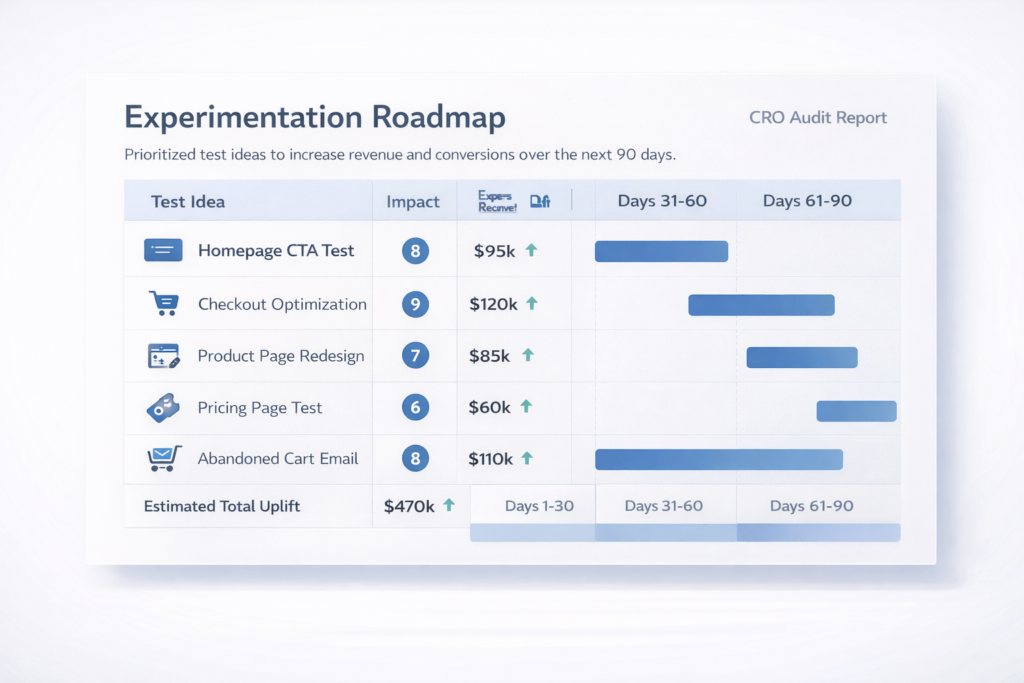
Here is what a strong first 90 days with a CRO testing agency typically produces:
- Month 1: Full research audit — analytics review, heatmap and recording analysis, funnel mapping, hypothesis backlog built and prioritized.
- Month 2: First 2 to 3 experiments launched on highest-impact pages. At least one test focused on form, CTA, or pricing presentation near the conversion point.
- Month 3: Winning variations shipped to production. Learning documentation updated. Second wave of tests launched based on first-round insights.
Over 6 to 12 months, a well-run experimentation program should demonstrate measurable lift in one or more of these:
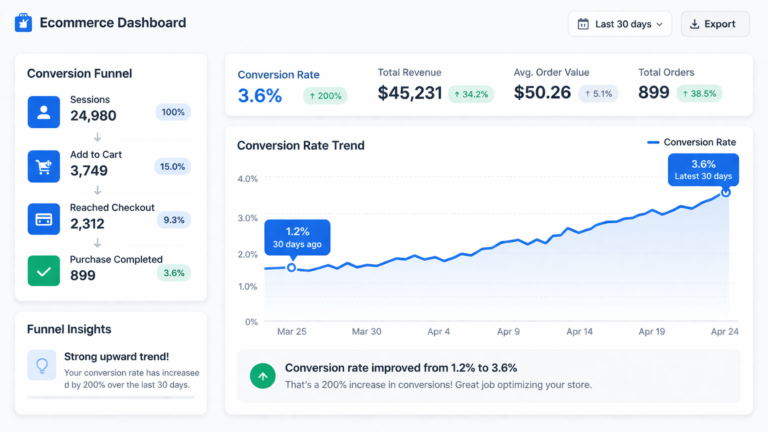
- Conversion rate — more leads, purchases, or bookings from the same traffic.
- Revenue per visitor — higher average order value or better lead-to-close rate.
- Cost per acquisition — lower CPA on paid ads because landing pages convert better.
- Page-level performance — specific pages moving from below-average to top-performer status.
If an agency cannot show you these kinds of outcomes after two quarters, something is broken in the research, the experiment design, or the implementation process.
How A/B Testing Connects to CRO, Paid Media, and Development
A/B testing does not exist in a vacuum. The experiment results are only as good as the systems around them.
CRO strategy gives testing its direction. Without a conversion rate optimization framework, you are guessing which pages to test and which metrics matter. The research phase should produce a ranked backlog of hypotheses — not a wish list.
Paid media gives testing its traffic. If your experiments run on organic traffic alone, reaching statistical significance can take months. Focused paid campaigns — especially to landing pages with one clear objective — accelerate learning speed dramatically. If your ads are underperforming, fixing the landing page often matters more than adjusting the campaign.
Development gives testing its durability. Every winning variation needs to ship as clean, performant production code. If the winning variant lives only inside a testing tool’s JavaScript overlay, you are carrying technical debt and risking performance degradation. A capable web development team ensures winners are properly built, QA tested, and deployed.
The best A/B testing agency partners can either provide all three capabilities or integrate cleanly with your existing marketing and engineering teams. Siloed experimentation without CRO strategy, traffic management, or development support produces slower results and more waste.
How Much Does an A/B Testing Agency Cost?
Pricing varies widely depending on scope, test velocity, and whether the agency also handles implementation.
Typical ranges for a conversion rate optimization agency with experimentation services:
- $2,500 to $5,000 per month — Research, hypothesis development, and 1 to 2 tests per month. Best for smaller sites or early-stage programs.
- $5,000 to $10,000 per month — Full research, 3 to 4 tests per month, implementation support, monthly reporting. Suited for mid-market companies with meaningful traffic.
- $10,000 to $25,000+ per month — Enterprise experimentation programs with dedicated strategists, custom tool integrations, multivariate testing, and executive reporting.
The question is not “how much does it cost” but “what is the revenue impact of improving conversion rate by even half a point?” For a site generating $500K per year in revenue, a 0.5% conversion rate improvement can be worth $50K to $100K annually — depending on traffic volume and average deal size. That makes even a $7K monthly retainer a strong ROI if the agency delivers.
Industries Where A/B Testing Agencies Deliver the Most Impact
Experimentation works across verticals, but certain business models see outsized returns from working with a website testing agency:
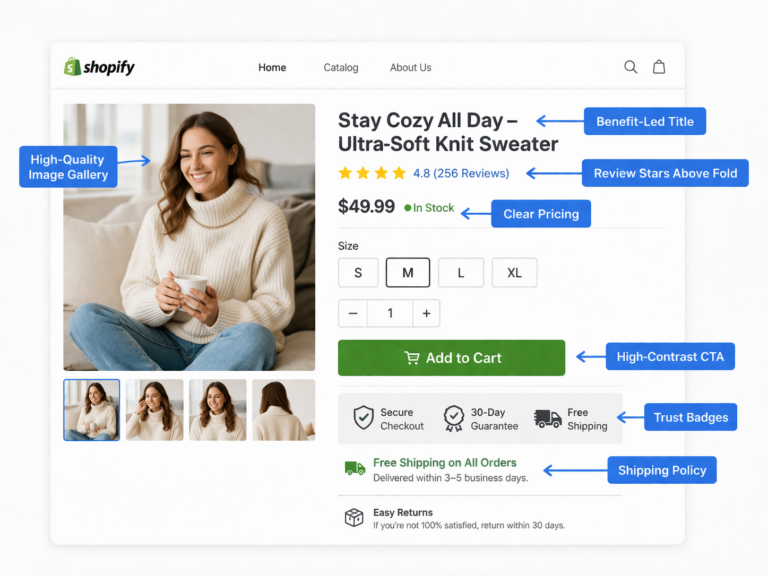
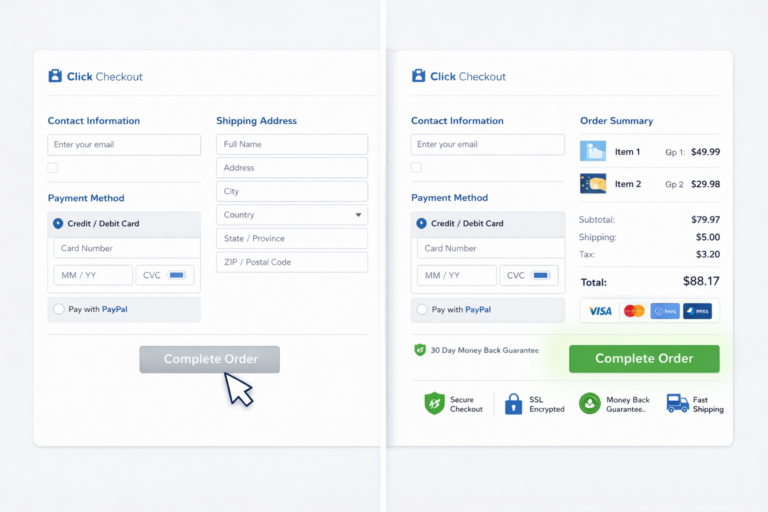
- Ecommerce — Product pages, cart flows, and checkout are high-volume, high-stakes conversion points. Small lifts multiply fast across thousands of daily sessions.
- SaaS — Trial signups, demo requests, and pricing pages are concentrated decision points. Testing headline, CTA, and pricing framing can measurably shift pipeline.
- B2B services — Lead forms, case study pages, and consultation booking flows are the revenue bottleneck. Even modest conversion improvements compound against long sales cycles and high deal values.
- Healthcare and finance — Compliance constraints mean changes need to be deliberate and documented. A structured testing process with documented hypotheses and results is both a growth lever and a risk control.
- Education and membership — Enrollment pages, pricing tiers, and onboarding flows benefit from testing different value framings and proof formats.
The common thread is traffic volume and conversion value. If each conversion is worth more than a few dollars and you have enough visitors to reach reliable results within a few weeks, a testing agency will almost always deliver a positive return.
How Site OptimizR Approaches A/B Testing as an Agency
At Site OptimizR, experimentation is not a standalone service. It is embedded in how we approach every client engagement. We start with research — analytics, recordings, funnel data, form analytics — and build a prioritized hypothesis backlog before any test launches.
Every experiment maps to a revenue-relevant metric. We do not test for the sake of testing. If a hypothesis cannot articulate what business outcome it expects to move and why, it does not make the roadmap.
When a test wins, we ship it. Our team handles the production implementation so the lift does not live inside a testing tool overlay. When a test loses, we document the insight and feed it into the next round. Over time, that learning library becomes a competitive advantage — we know what your audience responds to, not just what “best practices” say they should.
That is how experimentation compounds. Not by running more tests, but by running smarter ones — each informed by the last.
Get a Free CRO Audit Before You Hire Any Testing Partner
Before you commit to an A/B testing agency, you need clarity on where your biggest conversion gaps actually are. A focused audit reveals the pages bleeding revenue, the friction points driving visitors away, and the highest-confidence test opportunities hiding in your data.
Site OptimizR offers a free CRO audit that covers funnel analysis, page-level performance, UX friction signals, and a prioritized list of experiment recommendations — so you can evaluate any testing partner with real data, not sales decks.
Get your free CRO audit and see exactly where experimentation can move the needle for your business.