

Free conversion audit
Get a tailored action plan based on your current funnel.
Recharge vs Bold is not a one-price comparison. Both Shopify subscription apps publish a monthly platform fee plus a usage charge, and each tier changes the economics. Recharge starts lower for qualifying new stores with no more than 50 lifetime subscription customers, while Bold publishes three paid tiers with decreasing percentage fees.
Your decision should also account for merchandising, customer self-service, cancellation handling, failed-payment recovery, integrations, developer access, and migration. A cheaper invoice can be costly if it adds support work or limits a required workflow.
This guide uses official pricing pages, help documentation, developer documentation, and Shopify App Store listings checked on September 3, 2026. The cost examples are transparent illustrations, not vendor quotes or promised results.
Recharge vs Bold: The Quick Verdict
Choose Recharge when its customer portal, retention stack, analytics, integration ecosystem, or higher-tier development tools match an established program. Recharge also offers a $25 entry plan for eligible new merchants with 50 or fewer cumulative lifetime subscription customers.
Choose Bold when its merchandising tools and lower percentage rates fit your subscription model. Bold’s public Grow and Scale tiers can produce lower platform-fee math than Recharge Starter at meaningful recurring volume, but you must verify which features and integrations your implementation requires.
Do not migrate from a working platform for price alone. Calculate total cost against real subscription revenue and orders, then place an economic value on the operational gaps the change would solve.
Recharge vs Bold Pricing and Transaction Fees
The Recharge Shopify App Store listing shows a $25 monthly plan for qualifying new stores with no transaction fees for their first 50 subscribers. Recharge Starter is $99 per month plus 1.49% and $0.19 per transaction. Plus is $499 per month plus 1.34% and $0.19 per transaction, with scalable rates noted for growth.
Recharge’s billing documentation says the qualifying entry plan depends on cumulative lifetime subscription customers, not the number currently active. It also explains that Starter fees apply to the total processed amount and can include shipping, taxes, refunded orders, and one-time products in mixed charges.
The Bold Shopify App Store listing shows Launch at $24.99 per month plus 2%, Grow at $49.99 plus 1%, and Scale at $74.99 plus 0.9%. Bold lists a 30-day trial and unlimited subscribers on the paid plans.
| Public plan | Base fee | Published usage charge |
|---|---|---|
| Recharge qualifying 25–50 plan | $25 | No transaction fee for first 50 subscribers |
| Recharge Starter | $99 | 1.49% + $0.19 per transaction |
| Recharge Plus | $499 | 1.34% + $0.19 per transaction |
| Bold Launch | $24.99 | 2% |
| Bold Grow | $49.99 | 1% |
| Bold Scale | $74.99 | 0.9% |
Confirm what each vendor includes in the fee base, whether refunded or mixed orders remain chargeable, and whether a negotiated quote supersedes the public listing.

Worked Fee Example at Two Subscription Volumes
Assume a hypothetical store has a $50 average subscription order. At $25,000 in monthly subscription revenue and 500 orders, published fee math produces these estimates: Recharge Starter $566.50; Bold Launch $524.99; Bold Grow $299.99; and Bold Scale $299.99.
At $100,000 and 2,000 orders, the same mechanical calculation gives Recharge Starter $1,969; Bold Launch $2,024.99; Bold Grow $1,049.99; and Bold Scale $974.99.
Those numbers exclude taxes, add-ons, annual terms, negotiated rates, payment-processing fees, implementation work, and differences in what each vendor counts. Bold Launch becomes more expensive than Recharge Starter in the higher example because its 2% rate outweighs the lower base fee. That is why plan selection matters as much as vendor selection.
Subscription Merchandising and Checkout Fit
Both platforms work with Shopify Checkout and support common subscription models. Recharge Starter lists a subscription-first product-page widget, upsells and cross-sells, customer self-service, prepaid subscriptions, and gifting. Recharge Plus adds customizable bundles and tiered discounts.
Bold lists customizable delivery frequencies, fixed-date and order-based plans, prepaid subscriptions, curated and build-a-box models, dynamic discounts, product add-ons, and subscription upsells. Its product page also emphasizes default-to-subscribe and try-before-you-subscribe configurations.
Test the exact offer you sell. A coffee refill, curated beauty box, prepaid gift, and configurable bundle create different constraints. Verify variants, inventory, shipping, discounts, accelerated payments, taxes, and what happens when a product is unavailable.
Use a mobile-first duplicate theme and follow the complete path into Shopify checkout. Our Shopify checkout optimization guide covers the trust and friction around that path. A flexible subscription rule is only useful when a shopper understands the price and delivery schedule before paying.
Customer Portal and Subscriber Self-Service
Recharge publishes a no-code customer portal where subscribers can skip, swap, reschedule, and manage subscription details. Bold advertises a full customer portal with product swaps, price and product bulk updates, add-ons, and upsell opportunities.
Evaluate both portals with six tasks: skip the next order, swap a variant, change frequency, update payment, add a one-time product, and cancel or pause. Measure completion, errors, time, and whether the person needs support.
Also test authentication. Confirm the portal works with your Shopify customer-account configuration, email delivery, and support process. A portal that looks polished but creates login loops shifts cost into tickets and unwanted cancellations.

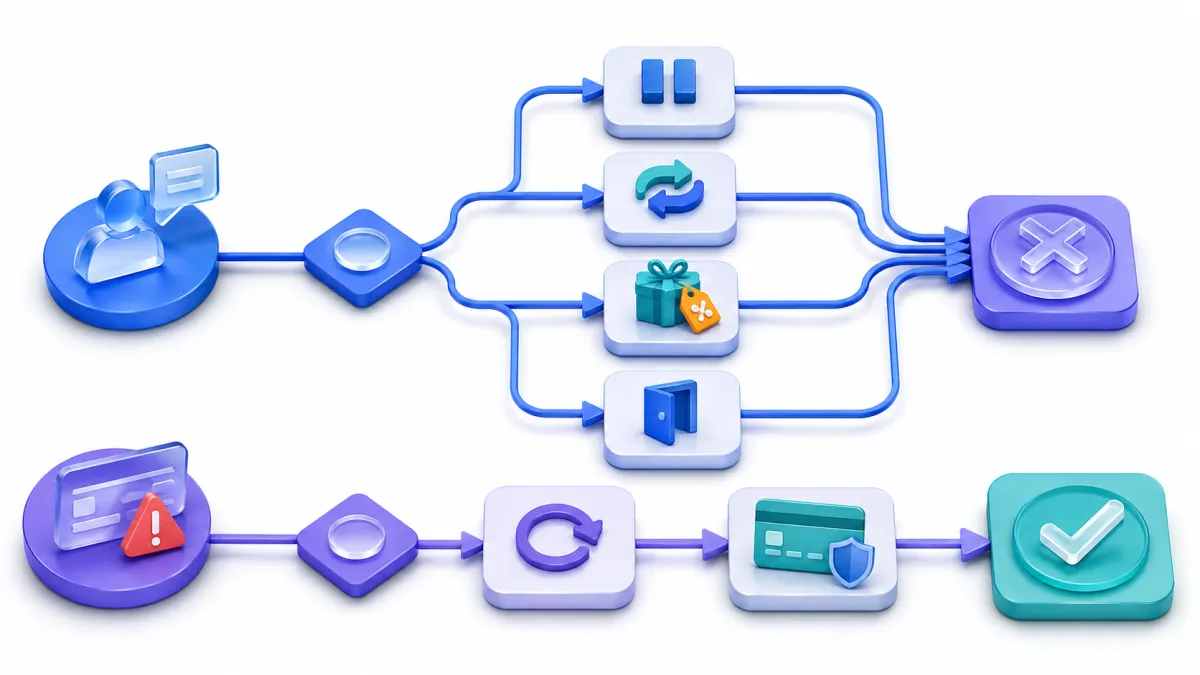
Cancellation, Dunning, and Retention Tools
Recharge Starter includes Smart Cancellation Prevention, Failed Payment Recovery, win-back tools, automated workflows, and analytics benchmarks. Recharge Plus adds rewards, referrals, and more implementation support.
Bold includes cancellation flows, automatic dunning, grace periods, payment retries, and retention-focused add-ons. Its higher Ultimate Retention tier includes a ProsperStack component, dedicated onboarding, and priority support.
Feature availability does not prove retention performance. Configure alternatives around the selected reason: too much product should offer skip or frequency changes; product dissatisfaction may need a swap; payment failures need retries and a clear update path. Avoid giving every cancellation attempt the same discount.
Track cancellation starts, completed cancellations, pauses, skips, swaps, incentives accepted, recovered payments, repeat cancellation, and support contacts. Report saved revenue net of discounts so a generous offer does not look more profitable than it is.
Analytics, Integrations, and Developer Access
Recharge Starter includes analytics and industry benchmarks. Plus adds the JavaScript SDK, Storefront API, broader bundle controls, and hands-on implementation. Recharge also publishes a substantial API and integration ecosystem.
Bold provides subscription APIs and webhooks, and its developer documentation covers subscription, customer, payment-method, and reporting operations. Bold’s listing names connections such as Klaviyo, Zapier, Churn Buster, and ProsperStack, while exact availability can depend on the plan and configuration.
Build an integration contract before the sales call. List required systems, the event or field each needs, sync direction, expected delay, backfill behavior, error visibility, and the plan that unlocks it. An integration directory logo does not prove the workflow you need.
Recharge vs Bold Migration Risk
A subscription migration changes a live billing operation. Active contracts, future charge dates, variants, discounts, addresses, prepaid schedules, and payment references must stay aligned.
Recharge documents a migration process and dedicated migration support. Bold’s Shopify listing advertises complimentary white-glove migration from other subscription apps. Neither statement removes the need for your own export, reconciliation, storefront test, and rollback plan.
- Inventory active, paused, cancelled, prepaid, and failed-payment subscriptions.
- Export source records and preserve a secure historical copy.
- Confirm payment-method compatibility and ownership of the migration mapping.
- Test new purchases, portal tasks, notifications, taxes, shipping, and renewals.
- Approve reconciled counts before stopping the platform that currently bills customers.
- Monitor upcoming charges and support contacts through at least one renewal cycle.

Which Shopify Stores Fit Bold or Recharge?
Choose Bold when merchandising and fee structure fit
- You need its prepaid, fixed-date, build-a-box, add-on, or upsell configurations.
- Grow or Scale produces better fee math at your real subscription volume.
- Your required integrations and developer workflows are verified in the selected plan.
- You have tested the portal and retention flows in your theme and customer-account setup.
Choose Recharge when operational depth fits
- You qualify for the new-store entry plan and want to validate subscriptions at low volume.
- You need Recharge’s portal, retention, analytics, benchmarks, or integration ecosystem.
- You are already on Recharge and the savings from a migration do not outweigh cutover risk.
- Your program needs Plus-level implementation, bundle, loyalty, or API capabilities.
For a wider shortlist, see our best Shopify subscription app comparison. This page is designed for the final Recharge-versus-Bold decision.
How to Run a Recharge vs Bold Evaluation
- Export baseline metrics. Capture recurring revenue, orders, active subscribers, churn, payment failures, save outcomes, and ticket volume.
- Calculate twelve-month fees. Use monthly revenue and order forecasts, including mixed orders and refunds where applicable.
- Configure one representative offer. Match products, frequencies, discounts, shipping, and portal actions.
- Test critical journeys. Cover purchase, renewal, failed payment, cancellation, skip, swap, and support escalation.
- Validate data movement. Confirm events and fields in email, support, fulfillment, finance, and analytics tools.
- Score migration risk. Document data ownership, payment handling, preview approval, cutover, and rollback.
Run the comparison against explicit pass criteria. Avoid changing merchandising, incentives, app, and email timing at once because you will not be able to isolate the cause of any movement.
Get a Free Subscription Funnel Audit
Your subscription platform should make the first purchase clear, self-service easy, and recurring revenue measurable. Site OptimizR can audit your offer, product-page widget, checkout path, portal, cancellation flow, integrations, and fee model.
Book your free subscription funnel audit before you migrate or renew. You will receive a prioritized recommendation tied to your store’s economics and customer experience.