Free conversion audit
Get a tailored action plan based on your current funnel.
Subscription revenue is the closest thing to predictable income a Shopify store can build. It lowers customer acquisition cost per repeat order, raises LTV, and reduces the revenue volatility that kills brands between ad cycles. It is also the area where a single wrong app decision costs you more than almost any other Shopify tool — because subscription apps charge transaction fees on every order, and at scale those fees dwarf the monthly subscription line item on your bill.
Most subscription app comparisons stop at the monthly price. This one goes further: transaction fee math at real subscription volumes, checkout extensibility compliance, cancellation save flow depth, and how difficult each app is to migrate away from if you pick wrong. This is the 2026 comparison from a team that has moved client stores between every one of these platforms.
If you are building out your full conversion stack at the same time, this post pairs with our Shopify checkout optimization guide and our guide to increasing your Shopify conversion rate — the checkout experience for a first-time subscriber is one of the highest-leverage conversion moments on your store and worth testing in parallel with your app selection.
Disclaimer: All pricing, plan names, feature lists, and transaction fee rates in this article were verified directly from each vendor’s website and Shopify App Store listing in April 2026. Subscription app pricing changes frequently — vendors restructure tiers, adjust transaction fees, and rename plans without notice. Always verify current pricing on each vendor’s pricing page before committing. We are not affiliated with any of the apps reviewed below and receive no commission for any recommendation.
Why Subscription Revenue Changes the Math on Your Shopify Store
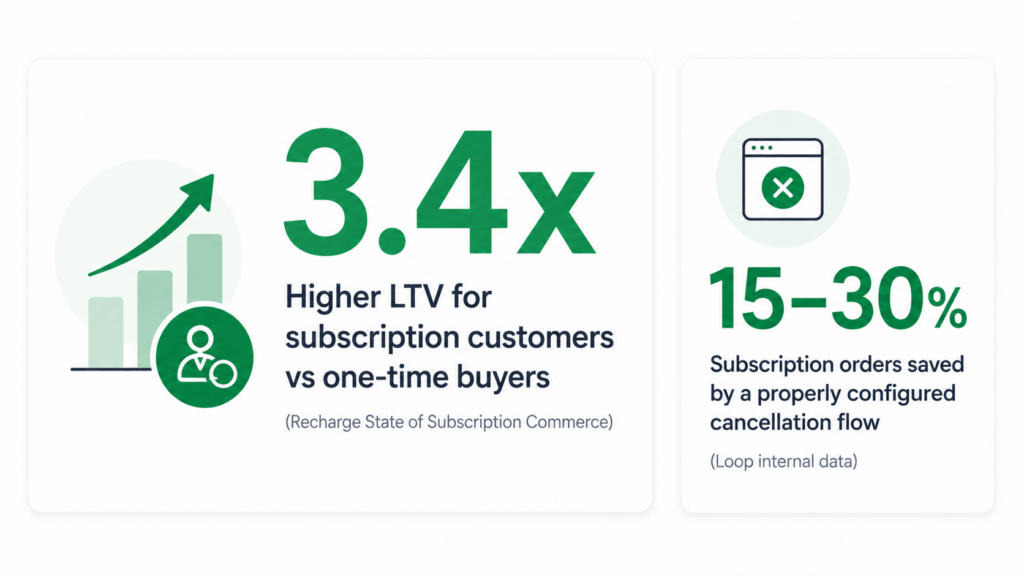
A one-time buyer who converts once is worth their initial order value. A subscriber is worth a multiple of that — typically 3 to 4 times the LTV of an equivalent one-time buyer over a 12-month window, according to Recharge’s State of Subscription Commerce report. That LTV premium is why subscription-enabled Shopify stores can profitably acquire customers at CPAs that would destroy a transactional-only brand running the same SKUs on the same ad platforms.
The mechanics are straightforward: you convert a customer once through your normal acquisition funnel, then you capture recurring revenue from every subsequent order at near-zero marginal acquisition cost. Subscription repeat orders have no ad spend attached, no influencer cut, no affiliate commission. They are pure incremental margin — and they are the difference between a brand that survives a Meta auction spike and one that cannot.
But subscription revenue requires infrastructure that standard Shopify checkout does not provide out of the box. You need a billing engine, a customer portal where subscribers can pause, skip, and swap, dunning management to recover failed payments, and cancellation flows to save churning subscribers before they leave. Every app on this list solves that problem differently — and every order placed without a subscription is revenue you will not see again next month.
The Five Apps Compared Head to Head
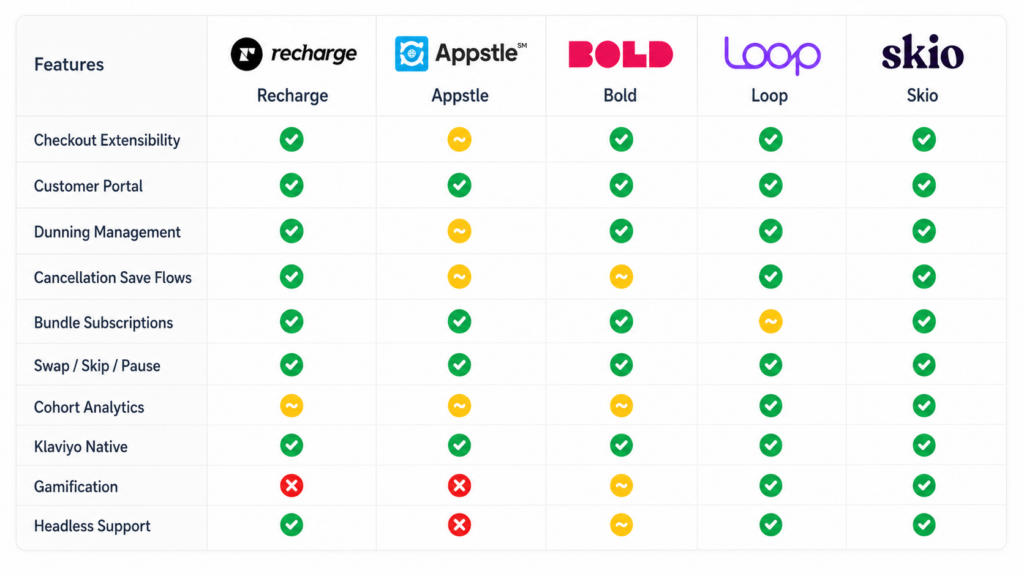
These five apps cover the overwhelming majority of Shopify subscription volume in 2026. If you are evaluating subscription tools for a Shopify store, your decision is almost certainly between these options. Here is what each one is actually built for.
Recharge — The Category Default
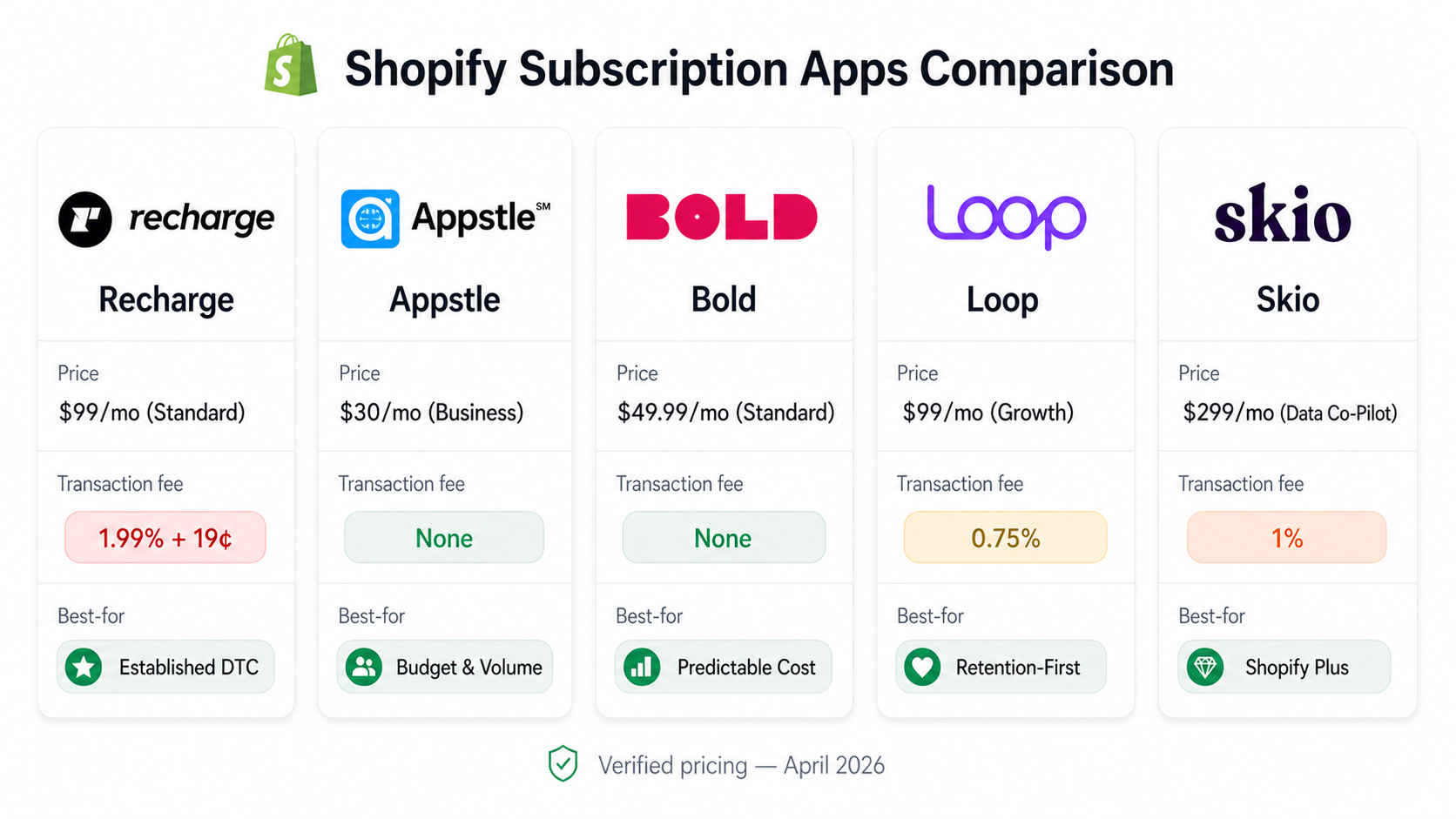
Recharge is the most-installed Shopify subscription app by revenue processed and brand name count. Brands like OLIPOP, Dr. Squatch, Ridge Wallet, and Pela Case all run on Recharge. Pricing has three main tiers: a Starter tier at $0/month for under 50 active subscriptions (plus 1.99% + 19¢ per transaction), Standard at $99/month (plus 1.99% + 19¢), and Pro at $499/month (plus 1% + 19¢). Enterprise plans are custom-quoted and include a dedicated account manager.
Strengths: deepest ecosystem integration in the category — Klaviyo, Gorgias, Attentive, and Postscript are all native; best-in-class cohort analytics and subscription reporting; the largest agency and integration partner network; strong dunning management with smart retry logic. Weaknesses: transaction fees are the highest at the Standard tier, customer support is notoriously slow on Standard (Pro and Enterprise get dedicated support channels), the admin UI has a learning curve, and migrating away from Recharge is harder than migrating away from any other app on this list.
Appstle — The Feature-Per-Dollar Champion
Appstle launched in 2021 and grew faster than any subscription app in Shopify history, driven almost entirely by merchant reviews — it consistently holds a 4.9-star average across thousands of reviews on the Shopify App Store. Pricing is aggressive: Starter at $10/month, Business at $30/month, Business Premium at $100/month, Enterprise at $200/month. Critically, Appstle charges no transaction fees at any tier — you pay the flat monthly rate only.
Strengths: no transaction fees (only app in the top five with this structure besides Bold), best feature set per dollar in the category, bundles and loyalty modules included at mid-tier, fast support response times. Weaknesses: analytics depth is significantly below Recharge’s, the UI is dense and occasionally confusing, ecosystem integrations are narrower at the enterprise level, and brand perception among larger DTC operations is still “challenger” rather than “established default.”
Bold Subscriptions — The No-Transaction-Fee Option
Bold Commerce has been a Shopify partner since 2012. Their subscription product went through a difficult V1-to-V2 migration that damaged merchant confidence for a period, but Bold Subscriptions V2 is now a stable, native Shopify Checkout-compatible product. Pricing is a flat $49.99/month with no transaction fees on Shopify’s native checkout. Bold also powers headless and custom checkout configurations for brands building non-standard storefronts — a use case none of the other apps here handle as cleanly.
Strengths: completely flat pricing with no transaction fees makes all-in cost fully predictable at any subscription volume, solid Shopify Checkout Extensibility support, strong headless and custom checkout capability. Weaknesses: fewer integrations than Recharge, cancellation flow tools are more basic than Loop’s, analytics are less detailed, and the V1-to-V2 migration history left some merchants skeptical even though V2 is solid today.
Loop Subscriptions — The Retention Specialist
Loop is the only app on this list built primarily around keeping subscribers rather than just processing their billing. Their differentiating features are gamified subscription mechanics — letting customers earn rewards for staying subscribed, swap products mid-cycle, and pause instead of cancel — combined with cancellation save flows that present dynamic offers based on the reason the subscriber selected in their exit survey. Pricing is $99/month for Growth (plus 0.75% per transaction) and $299/month for Scale (plus 0.5%). Enterprise plans are custom-quoted.
Strengths: best cancellation save flows in the category — brands running Loop typically report 15 to 30 percent of would-be cancellations saved via the exit flow, strong gamification and pause mechanics that reduce churn without triggering cancel events, good Klaviyo native integration. Weaknesses: transaction fees are still present (lower than Recharge but not zero), analytics dashboard is not as deep as Recharge’s, smaller ecosystem, and the gamification features require meaningful setup time to configure correctly.
Skio — The Shopify Plus Pick
Skio is the most premium app in the category, priced accordingly at $299/month (Data Co-Pilot) plus 1% per transaction, or $499/month (Platform) plus 1%. It is built specifically for Shopify Plus brands that want white-glove onboarding, fast support, and clean data architecture. Skio’s standout features are its passwordless customer portal — subscribers access their account via a magic link rather than a separate login, which reduces “I forgot my password” support tickets by 60 to 80 percent in practice — and its cohort analytics, which surface subscription churn by cohort the way a SaaS company tracks MRR.
Strengths: genuinely fast customer support (first response under two hours on any paid tier — the most meaningful practical differentiator vs Recharge), clean cohort analytics that operators actually use to make decisions, passwordless portal is a real UX improvement, strong Klaviyo and Postscript integration. Weaknesses: expensive, 1% transaction fee is the same as Recharge Pro despite a narrower ecosystem, overkill for stores under $100K/month in subscription revenue.
Transaction Fees — The Number That Matters More Than the Monthly Rate
The monthly plan fee is the least important number when evaluating a subscription app at scale. Transaction fees are what define your actual all-in cost — and most apps bury them in pricing page footnotes. Here is what Recharge Standard’s 1.99% + 19¢ actually costs at real subscription volumes:
- $5,000/month in subscription revenue (~83 orders at $60 AOV): ~$115/month in fees. Total with $99 plan: ~$214/month.
- $20,000/month in subscription revenue (~333 orders at $60 AOV): ~$461/month in fees. Total with $99 plan: ~$560/month.
- $50,000/month in subscription revenue (~833 orders at $60 AOV): ~$1,153/month in fees. Total with $99 plan: ~$1,252/month.
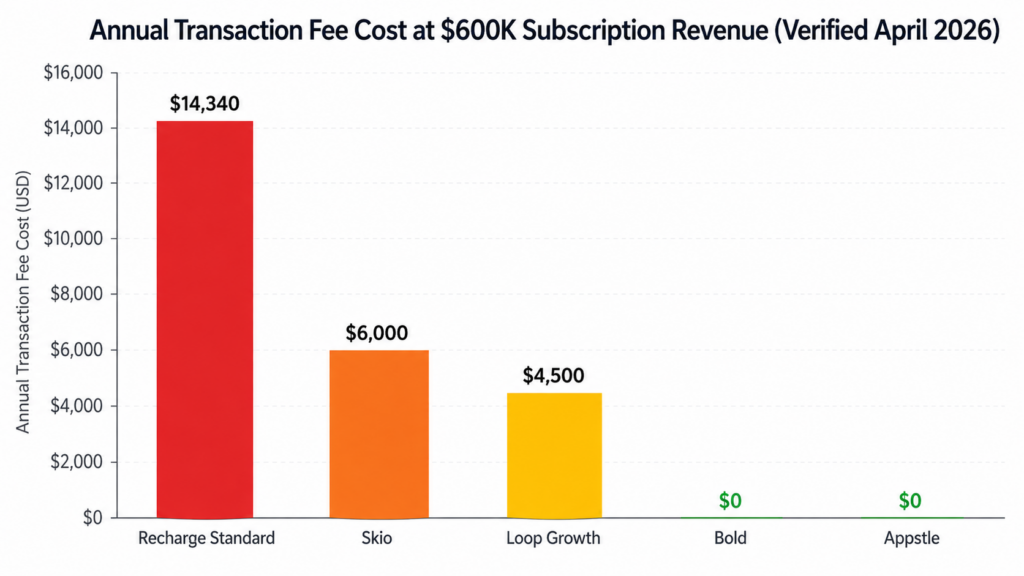
At $50,000/month in subscription revenue, Recharge Standard costs roughly $15,000/year compared to Appstle Business at $360/year for a comparable core feature set. That $14,640 gap is what your subscription app choice costs you annually before it generates a dollar of additional revenue. Bold and Appstle’s zero-transaction-fee structure makes them dramatically cheaper at any subscription volume — the math alone makes them worth serious consideration for stores where the cost savings are more immediately impactful than Recharge’s ecosystem depth.
The exception: if a more expensive app saves you enough through recovered failed payments, reduced churn, or improved subscriber LTV to cover the fee gap, the math can flip. Recharge Pro’s 1% vs Standard’s 1.99% saves approximately $7,000/year at $100K/month subscription volume — which more than covers the $4,800 annual plan upgrade. The Pro upgrade pays for itself the moment you cross $65K/month in subscription revenue and care about the ecosystem.
Real Pricing at the Practical Entry Tier (Verified April 2026)
Subscription app pricing pages use entry-tier headlines that do not reflect what most growing stores actually need. The practical entry tier for a store with 200+ active subscriptions needing Klaviyo integration, cancellation flows, and a branded customer portal looks like this:
| App | Plan | Monthly Flat Fee | Transaction Fee | All-In at $20K MRR |
|---|---|---|---|---|
| Recharge | Standard | $99 | 1.99% + 19¢/order | ~$560 |
| Appstle | Business | $30 | None | $30 |
| Bold | Standard | $49.99 | None | $49.99 |
| Loop | Growth | $99 | 0.75%/order | ~$249 |
| Skio | Data Co-Pilot | $299 | 1%/order | ~$499 |
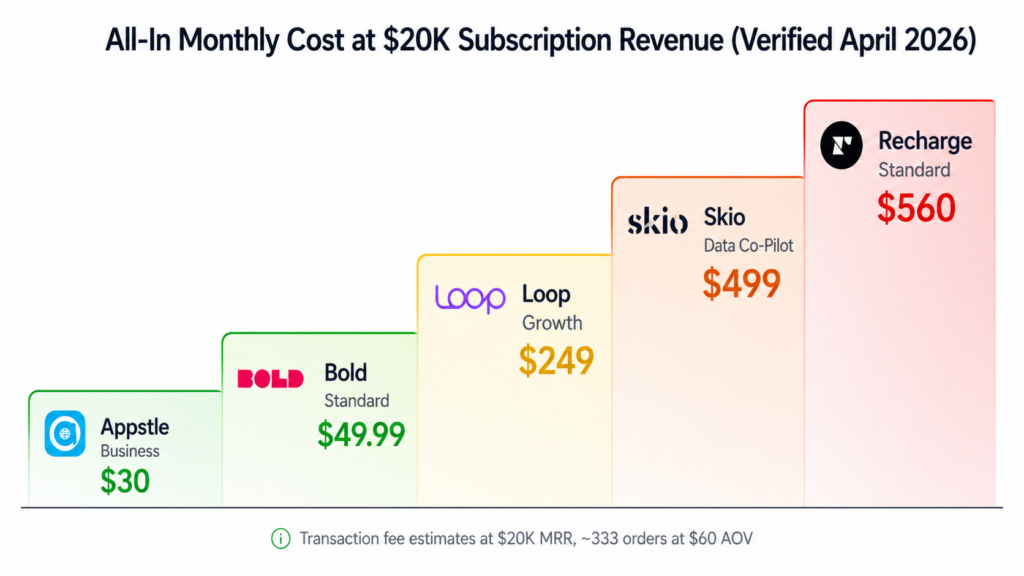
The Appstle and Bold numbers are not typos. At $20K/month in subscription revenue, Appstle costs 94 percent less than Recharge Standard for a comparable core feature set. The case for Recharge at this revenue band is ecosystem depth, analytics, and brand recognition — not price. If none of those three factors matter to you yet, Appstle or Bold will serve you more efficiently until they do.
Checkout Extensibility — Why This Is Now Non-Negotiable
Shopify announced the sunset of its legacy checkout customization API in August 2024. Every subscription app still using the old checkout injection method had to migrate to Checkout Extensibility — Shopify’s native checkout extension framework — or risk breaking their integration on every store they were installed on. All five apps on this list completed that migration and are fully compliant as of April 2026. This is now table stakes — if you are evaluating a subscription app not on this list, verify their extensibility status before installing.
What compliance means in practice: the subscribe-and-save checkout flow runs inside Shopify’s native checkout without redirects, without JavaScript injections, and without the checkout conflicts that plagued legacy subscription apps. The customer experience is cleaner, and you do not lose the Shopify checkout conversion optimizations — accelerated checkouts, Shop Pay, and native discount stacking — that the old injection methods often broke.
The checkout is also where you win or lose subscription sign-ups on first-time buyers. A frictionless subscribe-and-save offer at checkout — presented as an upsell to a one-time buyer — converts 8 to 15 percent of one-time buyers to subscriptions with no additional ad spend when the offer and discount are positioned correctly. See our Shopify checkout optimization guide for how to structure that test.
Cancellation Flow Capabilities — Where Most Subscription Revenue Is Won or Lost
Subscriber acquisition is expensive. A cancellation flow that saves 20 percent of cancellation attempts generates more LTV over 12 months than almost any other retention initiative you could run. The five apps handle cancellation saves very differently:
- Loop: Best in category. Dynamic offers — discount, pause, product swap — triggered by the cancellation reason selected in the exit survey. Brands report 15 to 30 percent save rates when the flow is configured correctly. This feature alone is Loop’s primary reason to exist.
- Recharge: Strong. Configurable cancellation reasons, static offers (discount codes, pause options), reliable save rates. Gets more sophisticated at Pro tier with access to Recharge’s flow builder and smart offers.
- Skio: Good. Clean UI for the cancellation survey, reasonable offer logic, roughly comparable to Recharge Standard in practical save rate.
- Appstle: Adequate. Basic cancellation survey and discount offers included at the Business tier. Not as sophisticated as Loop or Recharge Pro but functional for a store at $5K–$20K MRR.
- Bold: Basic. Cancellation reason capture exists but offer logic is limited. If subscriber churn is your primary problem, Bold is not the right pick.
The calculus: if churn is a larger problem than CAC for your store, start with Loop. The save flows alone typically justify the transaction fee premium over Appstle within 60 days on any store processing more than 200 subscription renewals per month. Run the math on your current cancellation rate before making the call.
Migration Reality — How Hard Is It to Switch Apps Later?
Subscription data is even stickier than reviews data. Active subscriber billing agreements, vaulted payment tokens, and order history all live inside your subscription app’s database. Migrating that data without causing billing failures — or forcing subscribers to re-enter payment information — is technically complex and often requires a custom migration script or a dedicated migration service.
- Recharge: Hardest to leave. Payment tokens are vaulted in Recharge’s own system. Migrating to another app requires Recharge to initiate a token transfer, which they support on Enterprise only. On Standard, you will likely need subscribers to re-authorize payment — expect visible churn spikes during the migration window.
- Appstle: Moderate. Has dedicated migration tools from Recharge and Bold. Payment token transfer works via Shopify Payments vaulting if both apps support it. Easier to leave than Recharge.
- Bold: Moderate. Migration tooling for moving into Bold is solid. Moving out requires coordination with support, but Bold is generally cooperative and well-documented.
- Loop: Moderate. Dedicated migration tools exist. Payment token transfer supported via Shopify Payments. Similar difficulty to Appstle.
- Skio: Easiest among the premium options. They actively advertise migration tooling as a selling point and provide hands-on migration support. Clean data export, clear process.
The strategic implication: if you are unsure which app fits your store long-term, start with the easiest to migrate from. Appstle or Bold gives you a low-cost entry point with reasonable exit paths. Committing to Recharge Standard at $20K/month MRR without being confident you need the full Recharge ecosystem is an expensive experiment with a painful exit.
Which App Should You Pick?
Here is the recommendation by store stage and primary problem. Use these as defaults — override when your specific situation demands it.
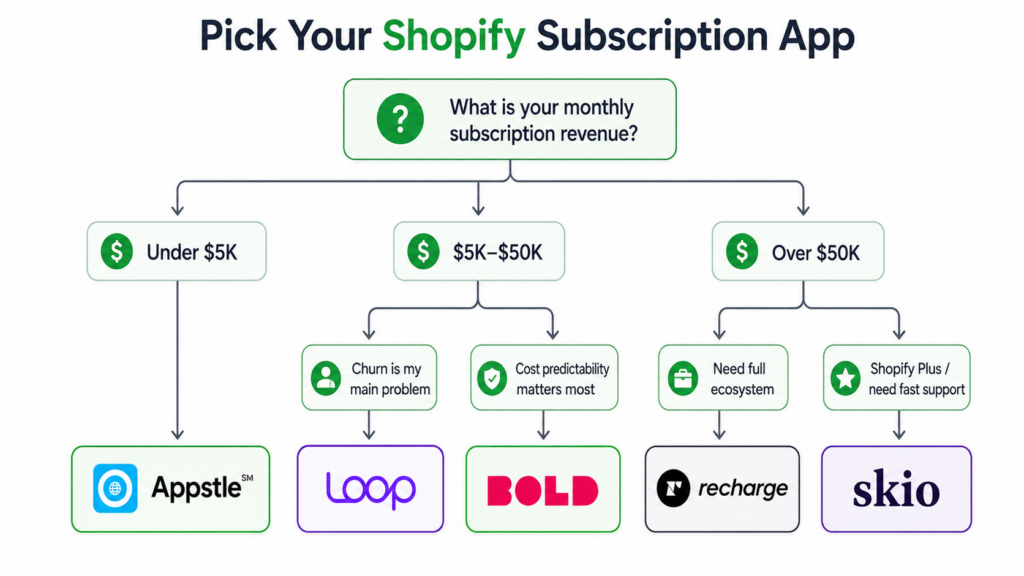
Under $5K/month subscription revenue: Appstle Business ($30/month)
Zero transaction fees, all the core features you need, and the savings versus Recharge Standard fund a meaningful chunk of your monthly ad spend. Do not overthink the tool at this stage. Collect subscriptions, measure your churn pattern at volume, and migrate when the feature gap starts to limit you. Appstle’s migration tools are good enough to make that transition clean.
$5K–$50K/month, churn is your main problem: Loop Subscriptions
If you are watching subscribers cancel and you do not have the infrastructure to stop them, the 0.75% transaction fee is worth it. A single month where Loop’s cancellation flow saves 20 percent of would-be churns on a $30K subscriber base returns more than the annual fee premium over Appstle. Install the flow, tune the offers by cancellation reason, and measure save rate within 60 days.
$5K–$50K/month, cost predictability matters more than features: Bold Subscriptions
Flat $49.99/month, zero transaction fees, fully Shopify-native, checkout extensibility compliant. If your margins are tight and you need completely predictable infrastructure costs without percentage-based surprises at scale, Bold is the right pick. Not the most feature-rich app on this list, but honest pricing and stable V2 infrastructure that works.
$50K–$500K/month, established DTC brand: Recharge Standard or Pro
At this revenue level you are in Recharge’s home territory. The ecosystem integrations — Klaviyo, Gorgias, Postscript, Attentive all native — the analytics depth, and the agency and partner network around Recharge become meaningful operational advantages that Appstle cannot match today. Evaluate the Pro upgrade using the transaction fee math: at $100K/month subscription revenue the 1% vs 1.99% difference saves roughly $7,000/year, which covers the $4,800 annual plan upgrade and then some.
Shopify Plus, complex catalog, or headless build: Skio or Recharge Pro
Choose Skio if fast support, clean cohort analytics, and a passwordless customer portal matter to your brand. Choose Recharge Pro if you are already deep in the Recharge ecosystem and need the broadest integration surface. Both cost roughly the same at Plus-level subscription volumes and both are defensible choices. The practical differentiator is support speed — Skio wins there by a wide margin.
Get Your Subscription Funnel Reviewed
Choosing the right app is the infrastructure decision. The conversion decision — how you present subscribe-and-save on the product page, how you structure the checkout offer, how you A/B test subscription frequency options — is a separate layer that most brands leave unoptimized. The app gives you the rails. What runs on those rails is what moves revenue.
Our team audits the full subscription funnel as part of our standard CRO engagement: product page presentation, checkout subscribe-and-save structure, customer portal UX, dunning sequence, and post-cancellation win-back flow. Most audits surface two or three changes that pay back inside 30 days.
Book a free strategy call and we will walk through your current subscription setup, identify the highest-impact lever, and give you a prioritized test roadmap — before you sign a long-term app contract you might regret.