Why Your eCommerce Store Can’t Rely on Google Traffic in 2025 (And What To Do Instead)

Zero-click results, AI summaries, and a bigger push toward paid placements.

In 2025, the odds are stacked higher than ever against eCommerce stores that rely solely on organic Google traffic.

Layer on top of that the constant algorithm shifts, Google’s core updates can swing traffic in a matter of days. Stores are left scrambling to rebuild their authority signals around E-E-A-T (Experience, Expertise, Authoritativeness, Trustworthiness).

At Site OptimizR, we’ve audited dozens of eCommerce businesses across multiple verticals. One thing is consistent: if you aren’t ready for volatility, your revenue can sink overnight.

So let’s break down how to respond when you see a sudden drop in traffic and more importantly, how to build resilience so that your store doesn’t live or die by Google’s whims.

First: How to Diagnose a Sudden Drop in Traffic

Before you panic and start rewriting product pages, confirm where the drop is really coming from.

Segment by source, device, and geography: Did organic traffic fall, or was it direct/referral? Was mobile hit harder than desktop? Did the dip occur only in certain regions? Dive into GA4, Search Console, and ad dashboards for clarity.

Eliminate technical problems: Did you introduce 404s, redirect loops, or downtime after a site update? Were GA or pixel tags removed by accident? Use uptime monitors and error logs.

Look for SEO changes: Did you lose backlinks, rankings, or content freshness? Check if key pages were updated, URLs renamed, or titles altered.

Factor in external shifts: Competitors and customer behavior matter too. If market conditions change (like seasonal buying or cultural events), traffic may dip even if your SEO is fine.

Evaluate bounce patterns: Did visitors start leaving faster? That could mean slower load times, irrelevant landing pages, or outdated products.

Once you’ve confirmed the cause, you can move into recovery mode.

Step 1: Recover and Grow Organic Traffic

Despite the challenges, organic search still delivers more than half of eCommerce traffic. Here’s how to keep it flowing in 2025.

1. Build Long-Tail Content That Matches Real Intent

People don’t just search “boots” anymore. They search “best waterproof boots for hiking in snow 2025.”

  • Publish fresh guides, comparisons, and how-to content that integrate product plugs.
  • Use long-tail variations in titles and subheads to capture intent.
  • Update content annually with terms like “Best [Product] in 2025” to stay relevant.
  • Refresh pages that rank in positions 8–20 with new CTAs and schema.

2. Leverage Rich Schema Markup

Schema is non-negotiable if you want enhanced visibility in AI-driven SERPs.

  • Add price, availability, and shipping schema to product pages.
  • Layer in review schema for star ratings and credibility.
  • Don’t forget brand/manufacturer schema for authority signals.

3. Optimize Faceted Navigation for SEO + UX

Faceted search can either tank your crawl budget or fuel a treasure trove of long-tail pages.

  • Create SEO-friendly landing pages for popular filters (e.g., “women’s waterproof hiking boots”).
  • Use clear URL structures (/boots/women/waterproof/ instead of messy parameters).
  • Noindex low-value filters, but index the ones with real search demand.

4. Adapt for AI Overviews

Google’s AI answers pull directly from structured and natural content.

  • Write product/category copy in plain language (“Available in red, navy, and sand”).
  • Add FAQ-style sections that directly answer common queries.
  • Align structured data with on-page copy, no mismatches.

5. Use Internal Linking to Strengthen Purchase Paths

Shoppers and Google both need clear pathways.

  • Create topic clusters linking guides, categories, and PDPs.
  • Add contextual links in blogs (“This compact grinder works in small kitchens — view here”).
  • Highlight bestsellers and curated picks inside collection grids.

6. Don’t Ignore Google Image Search

Visual search drives discovery.

  • Write descriptive alt text that includes both features and contexts.
  • Upload multiple angles and lifestyle images.
  • Add overlays like “Free Shipping” or “Best Seller” to stand out in image SERPs.

7. Earn Referral Traffic from Trusted Sites

Referral links diversify traffic and boost credibility.

  • Pitch niche blogs, review sites, and associations.
  • Contribute expert quotes for PR backlinks.
  • Offer affiliates or influencers bundles in exchange for placement.

8. Clean Up Technical SEO

Search engines can’t rank what they can’t crawl.

  • Merge duplicate product pages with canonicals.
  • Block crawl-waste parameters.
  • Simplify site architecture with clear hierarchy.

Step 2: Convert More of the Traffic You Already Have

Recovery isn’t just about more visitors, it’s about converting them.

1. Integrate User-Generated Content (UGC)

  • Place real customer photos and quotes on landing pages.
  • Curate UGC by use-case (“Perfect for small apartments”).
  • Turn UGC into micro-stories: “Set up in 5 minutes — finally clutter-free!”

2. Strengthen Trust Signals

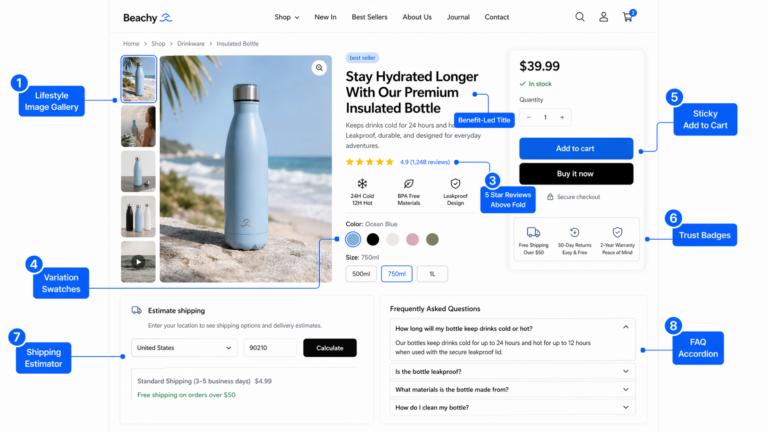
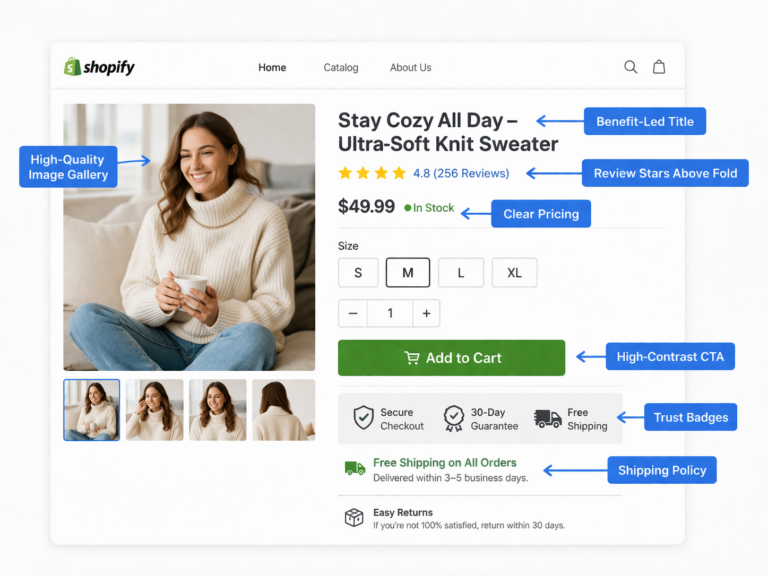
  • Add credibility proof above the fold (“Trusted by 10,000+ customers”).
  • Place star ratings beside product images.
  • Insert micro-testimonials into feature lists.

3. Create Intent-Driven Collection Pages

  • Replace generic labels with problem-solving names (“Oil-Free Moisturizers Dermatologists Recommend”).
  • Add curated benefit blocks above grids.
  • Link related collections inside banners (“Looking for eco-friendly options?”).

4. Refine Checkout for Mobile

  • One scrollable page, auto-advancing fields.
  • Offer BNPL options prominently.
  • Show reassurance (returns/shipping policies) without leaving checkout.

5. Use Natural Language in Product Titles

  • Swap “Model X200 Jacket” with “Lightweight Waterproof Running Jacket – Model X200.”
  • Highlight benefits (“Smooth & Low Acidity Coffee”).
  • A/B test title variations for CTR.

6. Add Context to Descriptions

  • Spell out use cases (“ideal for rainy commutes or weekend hikes”).
  • Layer scenarios by customer type (beginner, intermediate, advanced).
  • Place context snippets in image galleries.

7. Experiment with Video Content

  • Short explainer videos answering real questions.
  • Embed YouTube videos on PDPs.
  • Transcribe videos into FAQs for SEO.

8. Optimize FAQ Sections

  • Move top FAQs above the fold.
  • Auto-expand answers based on query intent.
  • Add CTAs directly inside answers.

9. Improve On-Site Search with Synonyms

  • Collect zero-result terms from Search Console and tickets.
  • Map synonyms at product and category levels.
  • Track conversion rate improvements from new mappings.

Final Word: Don’t Just Chase Traffic, Build Resilience

By now it’s clear: you can’t count on Google as your only growth driver. Core updates, AI overviews, and ad-heavy SERPs will keep reshaping the landscape.

The smarter play is two-fold:

  • Build layered organic strategies that survive volatility.
  • Optimize your site to squeeze more value out of every visitor.

At Site OptimizR, we help eCommerce brands do exactly that: turn fragile traffic into steady revenue through CRO and SEO combined.

Website Optimization for Higher Conversions and Better UX

Turn Your Website Into Your Best Sales Tool

Most websites have untapped revenue hiding in plain sight. At Site OptimizR, we help businesses unlock that growth, making your site faster, easier to use, and built to convert every visitor into a customer.

Why Optimization Matters Now

Getting people to your website is only half the battle. The real win is getting them to act, to buy, to book or to sign up. The difference between a website that “looks nice” and one that performs is often night and day.

Website optimization means more than just fresh design. It means:

  • Removing friction so users glide toward checkout or inquiry
  • Making every click, form, and page load faster and smoother
  • Guiding visitors intuitively, no matter the device or browser
  • Using hard data to refine what actually works, not just what looks good

That’s where Site OptimizR comes in.

What a Real Site Optimizer Delivers

A real optimizer is not just a plugin or another agency. It’s a dedicated partner that digs deep into how people actually use your site, identifies friction, and creates a plan to turn that friction into flow.

We handle:

  • Speed and performance upgrades that keep users engaged
  • Navigation and flow improvements that increase actions
  • Smart forms, sticky CTAs, and checkout flows that drive sales
  • Heatmaps and analytics to spot real bottlenecks
  • Mobile-first design so every user gets the full experience

Avoid the Pitfalls

If you’re shopping for optimization, don’t settle for:

  • Generic, copy-paste solutions that ignore your brand and audience
  • No communication or transparency about what’s actually being done
  • Random design changes without any A/B testing or analytics
  • Ignoring mobile and tablet users (where most of your conversions are hiding)
  • Neglecting site speed (a conversion killer)

Why Site OptimizR?

We don’t do cookie-cutter. We build a playbook around your business, your customers, and your goals. Every strategy is custom-built. Every change is tested. Every result is reported.

What You Get With Site OptimizR

1. Personalized Optimization Roadmap

We start with deep research, your audience, your competitors, your analytics and craft a strategy that fits your business, not someone else’s template.

2. True CRO Experts

Our team knows what moves the needle. We work on headlines, product pages, CTAs, checkout flows, and more, tracking every step with behavior tools, heatmaps, and session recordings.

3. Data-Driven Wins

We don’t guess. We run A/B tests, analyze real user journeys, and report back with before/after benchmarks so you can see the impact in plain English.

4. Total Transparency

You get regular updates, easy-to-read reports, and a dedicated point of contact. You’ll always know what’s happening and why.

5. Full-Funnel Approach

We don’t stop at the homepage. We optimize every step, from traffic source to final purchase or lead. If it impacts your bottom line, we make it better.

The Payoff

  • Higher conversion rates (without blowing up your ad spend)
  • Happier users who stick around and come back
  • Better ROI on every marketing dollar
  • A more credible, trustworthy online presence
  • Insight into what actually works for your audience

If your website is key to your revenue, optimization isn’t a nice-to-have, it’s a necessity.

Ready to See the Difference?

We’ve helped businesses in e-commerce, legal, health, education, and more turn their websites into profit centers.

We’ll help you do the same with clear strategy, technical expertise, and measurable results.

Unlock your website’s real potential.

Let Site OptimizR turn it into your best sales asset, working for you 24/7.

Book your free audit or call today and let’s get started!